I write this, with the small muscles around my ankles throbbing and bright red welts on my chest, trying to tell you why I like running.
Do I like running?
Like 40% of the times that I run, I’m pleasantly surprised by how much I’m enjoying it, but still excited to be done with it. Then 30% of the time, I’m just nonplussed and looking forward to being done with it. The other 30% of the time, every step feels unnatural and wrong and I’m really looking forward to being done with it.
I asked my boyfriend why the post-run period feels so amazing, beyond the endorphin high which is relatively short-lived. He, a seasoned marathoner of more than 28 marathons around the world, could immediately answer: “It’s the longest amount of time until your next run.”
I wasn’t into running until I started going out with the marathoner. I’m told it’s a normal phenomenon, for the non-running partner to take it up.
Someone I know clocked this immediately with great suspicion:
“Why are you suddenly into running?”
Defensively, knowing the question underneath is “Why do people change when they get a new partner?” I sidestepped, citing instead the efficiency of the running workout.
Rather than spend an hour and a half in the gym to get 25 minutes’ worth of weightlifting in, I can go outside and do a workout that takes me from my doorstep and back within 30-40 minutes, burning twice as much as I would at the gym.
That’s pretty sound reasoning. But of course, the fact that Himself’s whole life has running threaded through it like the laces through his Brooks sneakers makes a difference to me. I want to know what the big deal is, how can this person be so committed to this seemingly awful hobby?
What I initially viewed as something alien and unimaginable (anything over five kilometres) I slowly find more and more relatable, with the added effect that I become stronger the more that I understand it.
It’s something that I enjoy about getting close to a new person: seeing new aspects of the world that has always been around you.
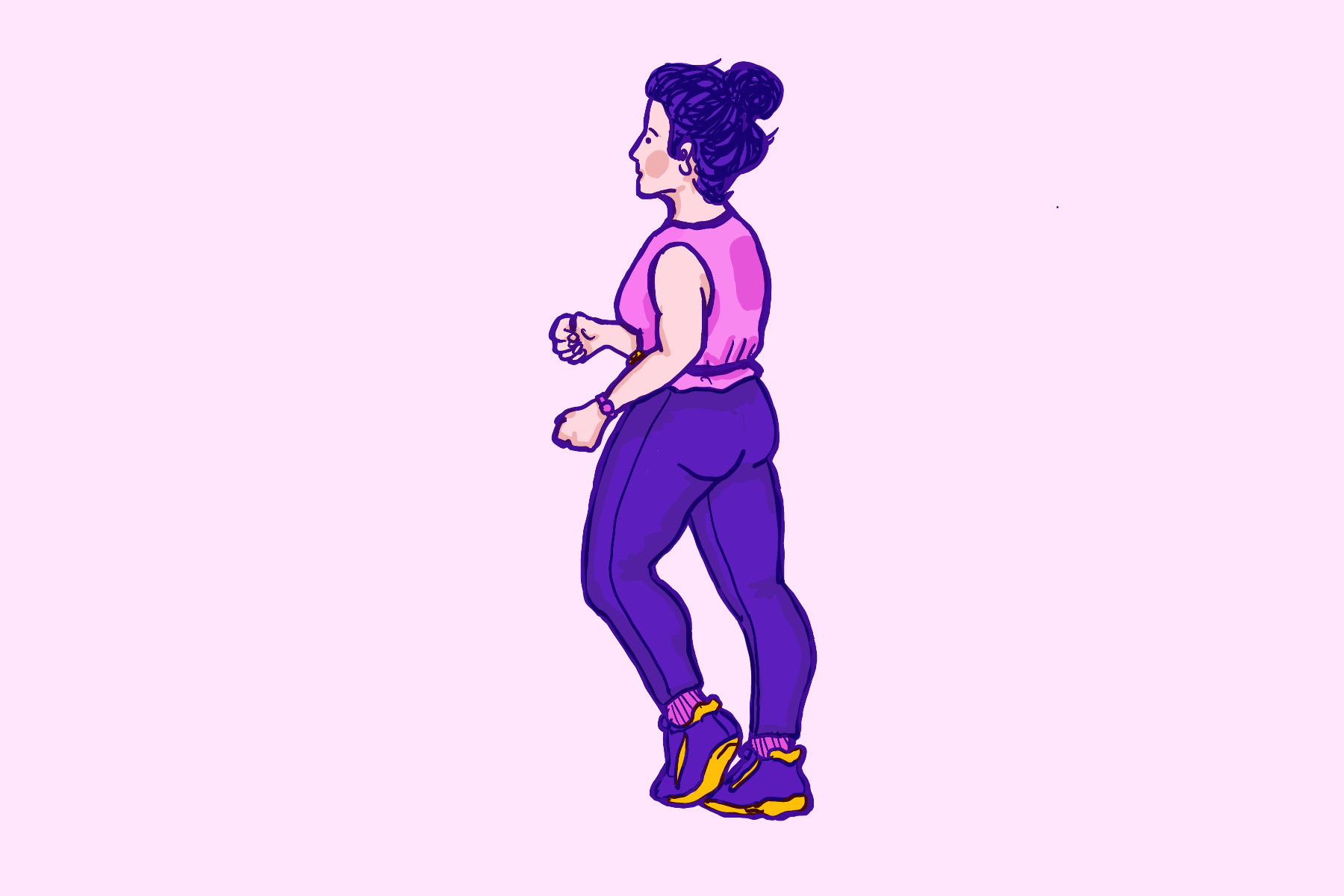
If she’s looks like she’s running quite slowly, it’s because she is.
It all sounds a bit romantic. Let’s get real for a second.
What’s shit about running?
Chafing
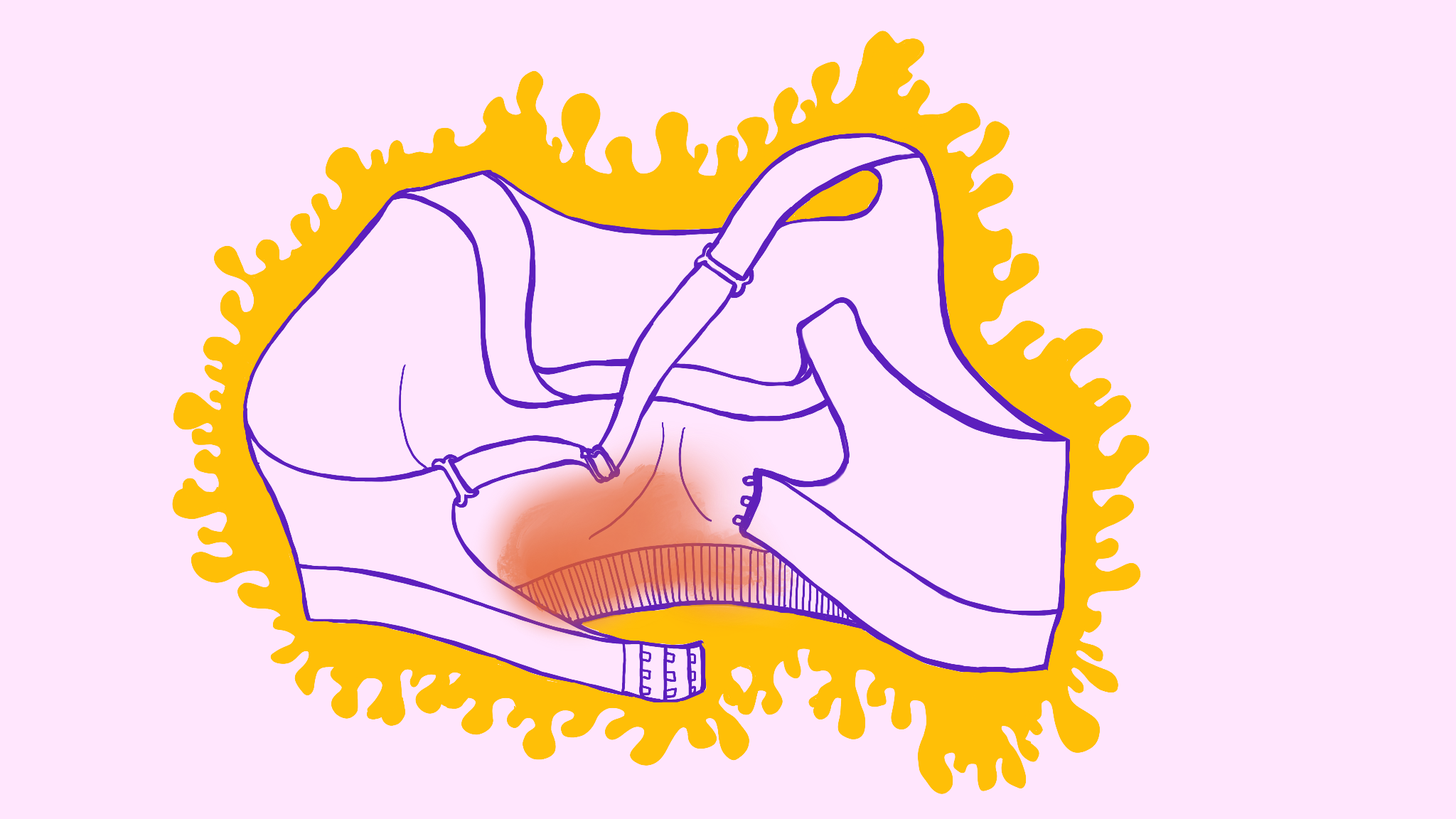
My bloodied, correctly-fitting sports bra.
I’m a sweaty woman, I’m not slender, I have a big chest: I am the ultimate chafer.
No longer a horror reserved for my inner thighs on a hot city break in summertime, chafing has left multiple wounds on my chest from running.
So far, I’ve been able to treat my skin after it chafes with Caldesene, which is a nappy rash powder. However, with one week where I clocked a total of 32km in seven days, the welts on my chest began to ooze and leave slimy deposits on my clothing. I could stand it no longer.
I will not have anyone with smaller breasts than me tell me that it’s simply a matter of getting a correctly fitting sports bra. I simply will not tolerate this. The small-tit-privilege brigade need to listen to my red, raw, lived experience.
I read forum after condescending forum where runners advise women like me to get a correctly fitting bra, as if previously I had simply been barging into the nearest shop and buying the first thing I thought might go over my chest. Here’s the irritating truth: if your body fluctuates in any way, there is no such thing as a consistently perfect-fitting item of clothing. My breasts are the harbingers of weight loss or gain, so they’re always going up or down. Correctly fitting bra, my hole.
I ended up buying some BodyGlide balm, which I apply pre-run, and I’m cautiously optimistic that it will help. The nappy powder remains indispensable, and I recommend it to everyone who has ever chafed. For the sweaty summer city break, apply stick deodorant to where you chafe, then Caldesene on anywhere that you did chafe. Then buy me a magnet or something for giving you this great tip.
Sore calves
I’ve always prided myself on my superhuman calves.
Were they honed by the rising trot during my years as a dedicated horse girl? Or did my two-year stint as a rower make them the rock-hard muscles they are today?
Another theory was supplied, unprompted, by a guy I once went on a few dates with. “You have fat-person calves!” he supplied, with no awareness that this was a somewhat loaded thing to say to a non-thin woman. “They’re strong because they’ve been carrying extra weight for all these years! I know cos I have them too.”
A good point, inelegantly made.
Whether it was any of these things, I had always assumed that there was no more that needed to be done to my calves, that they were basically complete. I was wrong.
I have discovered the existence of many tiny, very sensitive muscles in and around and above my ankles. This is based on vibes, by the way: I have not consulted any diagram of human anatomy. These tiny muscles, not a laboured heart rate, tend to be the thing which have me stopping for little rests where needed.
I thought I had big calf privilege, but running will always humble you.
Other runners
What’s “sweating”? I’m not familiar.
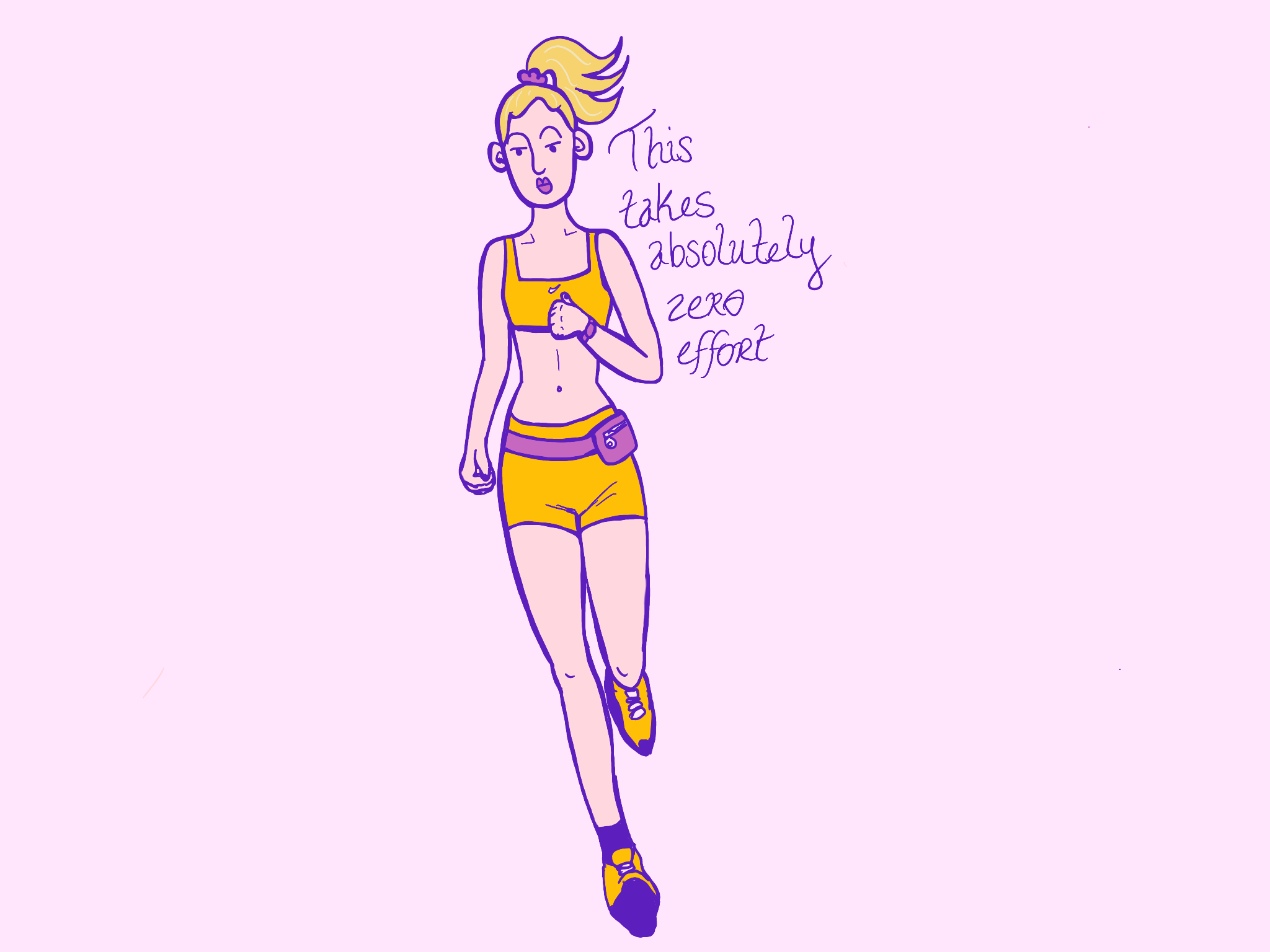
You don’t just encounter them in chafing forums. Out and about, they breeze past you, self-serious and in stupid amounts of gear. They’re probably just doing their regular 30 kilometre run, barely breaking a sweat, wearing a silly little vest. Their light-up clothing items seem to mock your sad little high-vis harness.
They’re always better than you, and they’re always so in the zone. They probably only eat yoghurt and protein shakes and take the most ridiculous shits. In real life, you’d barely clock them as they passed you on the street, but in running gear they make your teeth grind.
One thing to bear in mind: to some other runner, you are this person. Even I am this person to whatever runner I pass who is having a worse day than I am. We all ascribe an imagined smugness to the passing runner, that’s just the lot of the runner in life. It’s the price of the smugness that you really are feeling.
Back to the first question then. Do I like running?
I don’t like it, but I do love it. I seldom actively enjoy it, but I cherish it being in my life and I don’t want to lose it.
Here are the things that I can honestly say that I enjoy.
Post-run high
Most people say the runner’s high is something that hits during or just after the run. I seldom feel any kind of high during the run. For me, it’s a slow, unfurling glow that flows from my heart outwards to every limb and extremity in the hours after my runs.
Even though I’ve been exercising regularly for about three years now, I still feel gratitude (cheesy word, but it is what I feel) to myself every day that I choose to exercise.
Part of it is pride – I still don’t take for granted the fact that I did a run. After every run, I’m quite amazed that I put on the gear, stepped out into the evening, and delayed my comfort by an hour or so to do this thing that is good for me.
This leads me to my next enjoyable factor of running.
Mental health
I started exercising regularly after I quit drinking. After a week or so of no pints whatsoever, I found myself with an excess of energy and a renewed hunger for sugary sweets. Following an evening where I went first to Tesco, then to my local Spar, then again to Spar, to buy sweets three separate times, I decided to address these issues. I joined my nearest gym (which is handily situated a little nearer than the Tesco, and a little further than the Spar). That way, I’d have fewer hours in my evening to chow down on Haribo and somewhere to channel all that energy.
In the weeks that followed, I learned, with genuine disgust and disappointment, that the rumours were true: exercise is the quickest way to make you happier.
Even though I wasn’t seeing much physical change, I found that my negative body image was fading into the background. Using my body made me love it more.
Exercising after work feels like hygiene. It really feels like I’m scrubbing the stress from my mind. The things that build up throughout the day, that irritate and upset, that make your back tense up – you sweat them out. That snarky little email you got at half 4? You just wiped it out of your mind with the little towel you use to mop your brow.
But the gym has its drawbacks. One summer’s day, working from home, I had only my lunch break to get a workout in. I went to my gym and not a single machine was available. Sure, if I’d waited a few minutes, I’d have got something, but those minutes build up.
I had a brainwave, and stepped outside to the street. Within 40 minutes, I had run five kilometres and I still had time for a shower before going back to work.
I still like the gym, but now I realise that my unlimited access to the outside world is the most efficient means by which I can get in a workout and give my brain a good scrub.
A new city
When I quit alcohol, I saw less and less of pubs. Where I used to spend hours chatting with friends over pints multiple times a week, I often started feeling the mental chafing of the time after only one or two hours, and I only felt the inclination to go to the pub maybe once a week. When I quit smoking, my interest in pubs waned even further. I was also naturally a bit wary of being in environments which might tempt me towards a smoke or a drink.
But less time in pubs means more time at home. I spent less time experiencing the city where I live. At that time, going for 0.0 pints wasn’t really an option, as I was trying to fully break the habit, and it would have been a very easy “Oh, go on then” that would have had me picking up a real drink.
Running put me back in touch with Dublin. With the absolute and full awareness that most people reading this will find it difficult to suppress an eyeroll as they read it, I have really enjoyed getting to know Dublin by running its pavements, as opposed to my previous tactic of purchasing its pints.
As my capabilities grow, I need to go further and further, so I scour Google Maps with its “measure distance” tool. The city shrinks, week by week, under my lengthening routes. Its topography becomes instinct to me, its hills making the difference between a fun downhill jaunt or an excruciating slog. Nondescript garages become important landmarks, and previously prosaic stretches of not-very-much might become my new favourite portion of a route because of how the breeze blows or the slight decline.
Everyone rhapsodising about Walsh’s in Stoneybatter irritates me less now that I find myself romanticising that lovely hill from Phibsborough down to Smithfield. We’re all bores in our own way. In the great bore-off, I’m afraid runners always take the gold medal, even ahead of people who think Guinness is a personality trait.
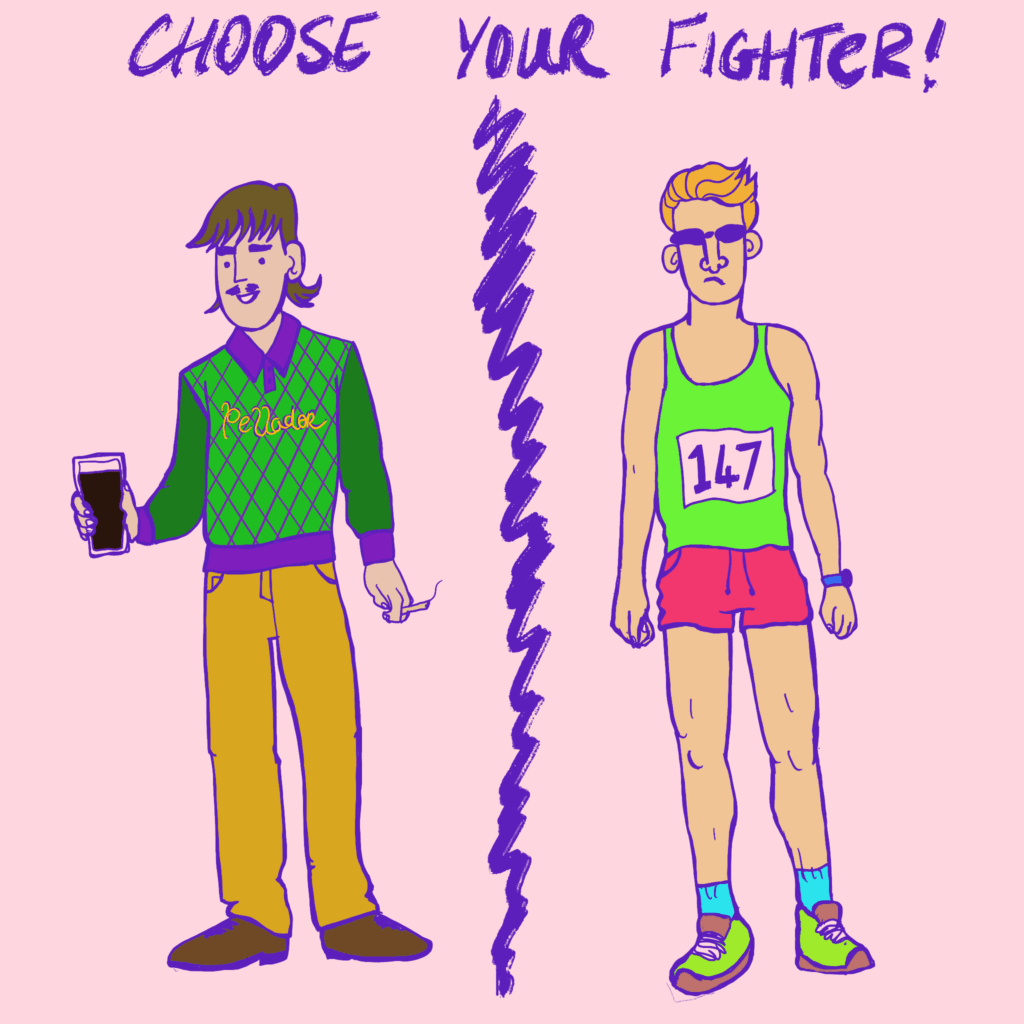
Someone said that if you mix these two, you get my boyfriend. That’s what I call balance. EDITOR’S NOTE: He has asked that I let you all know that he would never wear Pellador.
I never thought I’d be an exercise person, and I never really believed that exercise people were actually being truthful when they said that it was enjoyable and made them happy and all the rest of it.
But the sad fact is that it massively helps. Of course, having gone through many years where it felt totally inaccessible to me, there are both intangible and very real factors that act as barriers to exercise for many people. Lots of these factors are not in the person’s control.
But if you can, and if you’re exercise-curious, I highly recommend it. Find what works for you and you’ll find your mind is much lighter and clearer.
Thank you for coming to read this, and I invite you to subscribe below if you would like my new posts linked straight to your email.
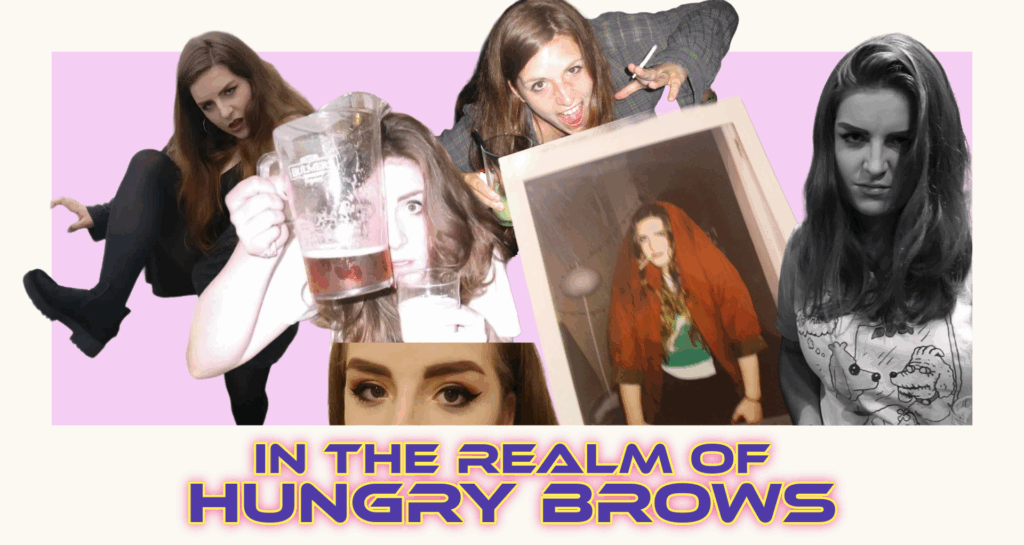
A portrait of the artist as a drunk young woman with gigantic or non-existent eyebrows
Please forgive my very long hiatus. I try to post on a fortnightly or, failing that, monthly basis, but I ended up having a very busy month, particularly with work, so this fell by the wayside.
Part of the slowness may also be due to a certain amount of trepidation on my part. I realised, in the process of writing this piece, that it ends up going into quite personal territory. I’ve wondered how much of that to cut and how much is interesting to the reader rather than me navel-gazing. That bothered me less when I was spotlighting my younger self, because it’s very easy and funny to clown on our teenage selves. There’s also a fear of self-indulgence: is this about music or is it about me? If the latter, the classic Irish thought comes to mind: why would anyone be interested in reading about me? I think it’s best to let the reader be the judge of that, so no worries if you don’t feel like reading all about my twenties.
In writing this, I also decided that there will not be a part 3 to the series, or at least not for a while. I think I need to let the years percolate a bit before I select any more albums that are definitive of these times of my life. I don’t want to prematurely editorialise my life and to end up selecting albums that are influenced by how I want to be perceived. I think, in a few years, I can look back at my late twenties with a more distant eye and see what emerges. Right now, it’s still too close to call.
Thank you for coming to read this, and I invite you to subscribe below if you would like my new posts linked straight to your email.
So, here they are. The three most important albums in my personal development from 2014 to 2019 or thereabouts. They’re actually all quite sad, and so was I at this time. But I was also having the most silly, youthful fun of my life.
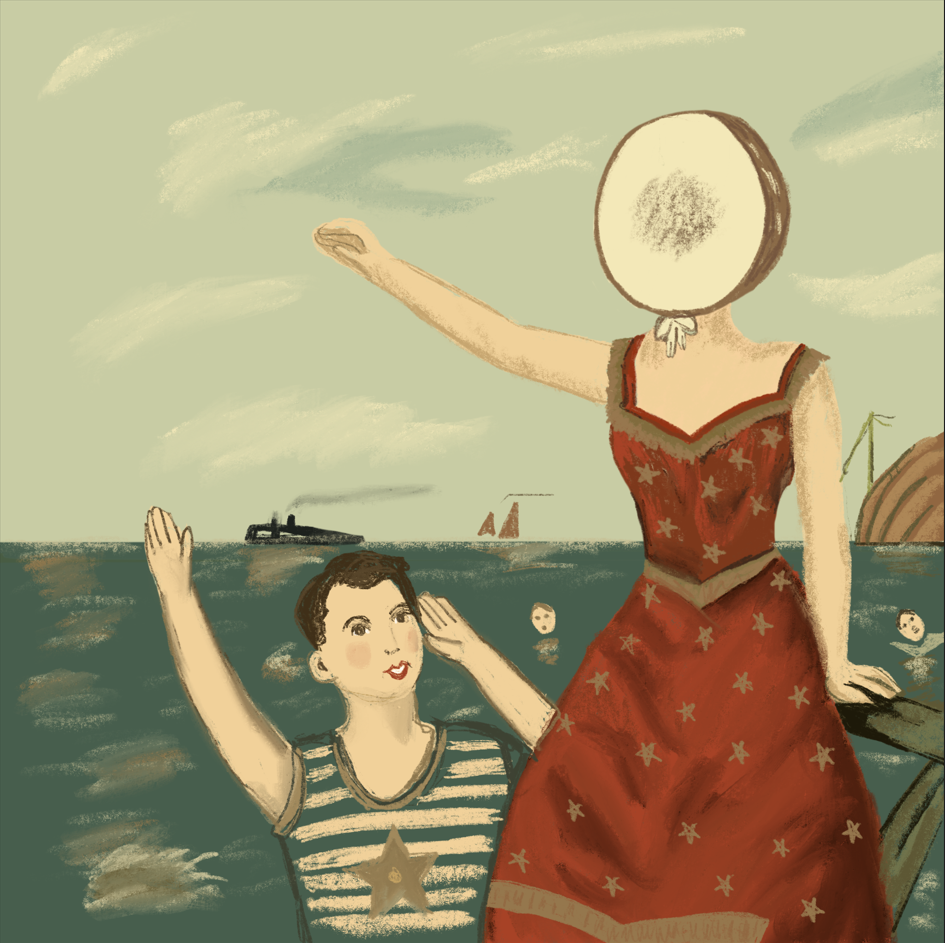
Neutral Milk Hotel – In the Aeroplane Over the Sea (or how “cool” can be so cool that it comes full circle and is unspeakably naff)
This is what Victorian Times was like
Oh, how delighted I was, a newly minted young adult, to find myself liking something that was undeniably cool. April Ludgate, fictional cool girl, was into this album. And how delightful, to have a cool album actually be interesting, and fun to listen to, and sad, and evocative…
This might be an embellished memory, like the one where my brother introduces me to Green Day. However, as I remember it, I was on campus in second year of university in Galway. I was at Smokey’s café on the concourse, meeting one of my best friends for coffee between lectures. He bounded up to me, unusually energetic, and sat down. As if I were a Hollywood exec and he a screenwriter, he began to pitch me In the Aeroplane Over the Sea by Neutral Milk Hotel.
“So it has hip hop bagbpipes and it’s about the singer being in love with Anne Frank,but not really like that, it’s more of an ideological thing, and growing up, and death, and puberty and being in love…”
Sold!
The next time we met, I was ready to discuss ITAOTS. Anyone overhearing our conversations about this album would have found us highly pretentious, but we had long decided that, in our friendship, we would lean heavily into being pretentious twats. We had always enjoyed discussing literature, and if we sounded like we thought we were very smart, it’s because we really did think we were.
ITAOTS really is an amazing album. It opens with acoustic strumming and the words “When you were young you were the king of carrot flowers,” whatever that means. Whatever it means, I know how it feels. The song is in the second person, narrating from the perspective of “you”, inviting you to accept the words that follow as yours, and implying a universality to the songs on the album.
It’s often considered to be an album about Anne Frank, and Neutral Milk Hotel frontman Jeff Mangum’s obsession with her. He has said that ‘a lot of the songs on this record are about Anne Frank”, and in the same interview (“Dropping in at the Neutral Milk Hotel” by Mike McGonigal) discusses how he read The Diary of a Young Girl by Anne Frank and spent the next three days crying.
For anyone who has not read The Diary, here is a brief description. It is the real diary of Anne Frank, who was murdered by the Nazi regime at the age of 15 at Bergen-Belsen concentration camp. It follows her life from the age of thirteen, when she is given a diary for her birthday. Shortly after that, she goes into hiding with her family in a secret annexe in Amsterdam. Her last entry is 1 August 1944, after which they were discovered. The only surviving family member was her father, Otto Frank, who then published her diaries in 1947.
Back to the album. In ‘Holland 1945’, the narrative voice is in love with her: “The only girl I’ve ever loved/Was born with roses in her eyes/But then they buried her alive/One evening 1945/With just her sister at her side”. This, alongside the strange and sometimes sexual lyrics that recur throughout the album, though never directed at or directly about Anne Frank (“Sweet communist, the communist daughter/Standing on the seaweed water/Semen stains the mountain tops”), has invited criticism of the lens through which Mangum seems to see her.
We’ll look a bit more at the book which inspired Mangum before we litigate this criticism.
The Diary of Anne Frank works on two levels. Reading it if you have ever studied literature causes you to see things that you think of as foreshadowing (when Anne thinks someone sees her through the window), or character development (her growing understanding of her mother and her sister, Margot). But then you remember that this is not foreshadowing or character development – this is life. This strange feeling seems to suggest that there is sense to life, and art imitates it in its forms. Real life holds portents or signs, just as fiction has foreshadowing. That feeling that there is a sense to life shudders to a halt as the diary ends and you remember that this person’s right to express themselves, to create, and finally even to life, was wrested brutally from them. You then mourn Anne, and suddenly, dizzyingly, you are compelled to consider that every person murdered by the Nazi regime had a life and inner voice as real and complex as Anne’s. The magnitude of human suffering stuns you.
The other level on which it works is that it is, as its title says, the diary of a young girl. Reading it at her age, I related to her friends and frenemies, her crushes, her fights with her mother and sister, the stress and mystery of the onset of puberty. That the writings of a young Jewish girl in the Netherlands in 1945 could resonate with a young Catholic girl in Galway in 2005 feels remarkable.
So, what is with Jeff Mangum’s weird declarations of love for her, and is it bad? Your mileage may vary on this one.
It’s worth noting to those who may not be very media literate that Mangum can write a song, as a writer can write a novel, without being the same person as the narrator. In fact, as we saw in the first lines of the album, the narrative voice is handed to the listener (“When you were young…”).
I think Anne Frank’s story serves as an emblem for the album, rather than being the literal focus. She’s never named explicitly, nor is she the only subject. Mangum’s lyrics span lifetimes (“now she’s a little boy in Spain/Playing pianos filled with flames”, “And one day in New York City, baby, a girl fell from the sky/From the top of a burning apartment building 14 stories high”), different stories threading in and out.
The parts about love are not about Jeff Mangum being in love with Anne Frank, they’re about being young, and the perseverance of youth against adult horror thrust upon it. “And your mom would stick a fork right into daddy’s shoulder/And dad would throw the garbage all across the floor/As we would lay and learn what each other’s bodies were for.” What seems to be constant is the album’s love of life itself, even among pain and destruction. I see it as a mourning of young lives cut short while celebrating the vitality and meaning of their time on earth.
The image that seems to confirm this is the last verse of ‘Holland 1945’: “And it’s so sad to see the world agree/That they’d rather see their faces filled with flies/All when I’d want to keep white roses in their eyes.”
The world remembers the sadness and horror, the “faces filled with flies”, but Mangum is advocating here for remembering the life and beauty, the “white roses in their eyes”. Both are important to memorialise, but ITAOTS is focusing on life, youth and potential, with sadness and loss as ways to emphasise the tenacity of hope.
Those are my feelings about the album. It’s complicated and weighty, and makes you think about bigger things.
I suppose the praise and cult status it gained in the decades following its 1998 release (such that two college students in 2014 felt very cool for liking it) also caused it to become a meme. On subreddits like r/indieheadscirclejerk, the tendency to put this album on a pedestal is lampooned.
While the album has some sincere detractors, the memes about ITAOTS is more about the sort of “flex” of saying you like the album. Listing the album as one of the best has become almost cringe. It has become a kind of shorthand for the type of person who wants to wants to be seen to like something complicated and high-falutin’.
For my part, I definitely did feel super cool and smart for liking this album, until the memes came. However, the album is legitimately good enough that this does not matter. I feel cooler sincerely liking something than I ever did trying to like the right things.
To anyone who thinks In the Aeroplane Over the Sea is pretentious, I would invite them to try to enjoy the entirety of Neutral Milk Hotel’s earlier album, On Avery Island. The greatness (‘Song Against Sex’, ‘Naomi’ and ‘Where You’ll Find Me Now’) is balanced by the absolute what-the-fuckery that is ‘The Pree Sisters Swallowing a Donkey’s Eye’.
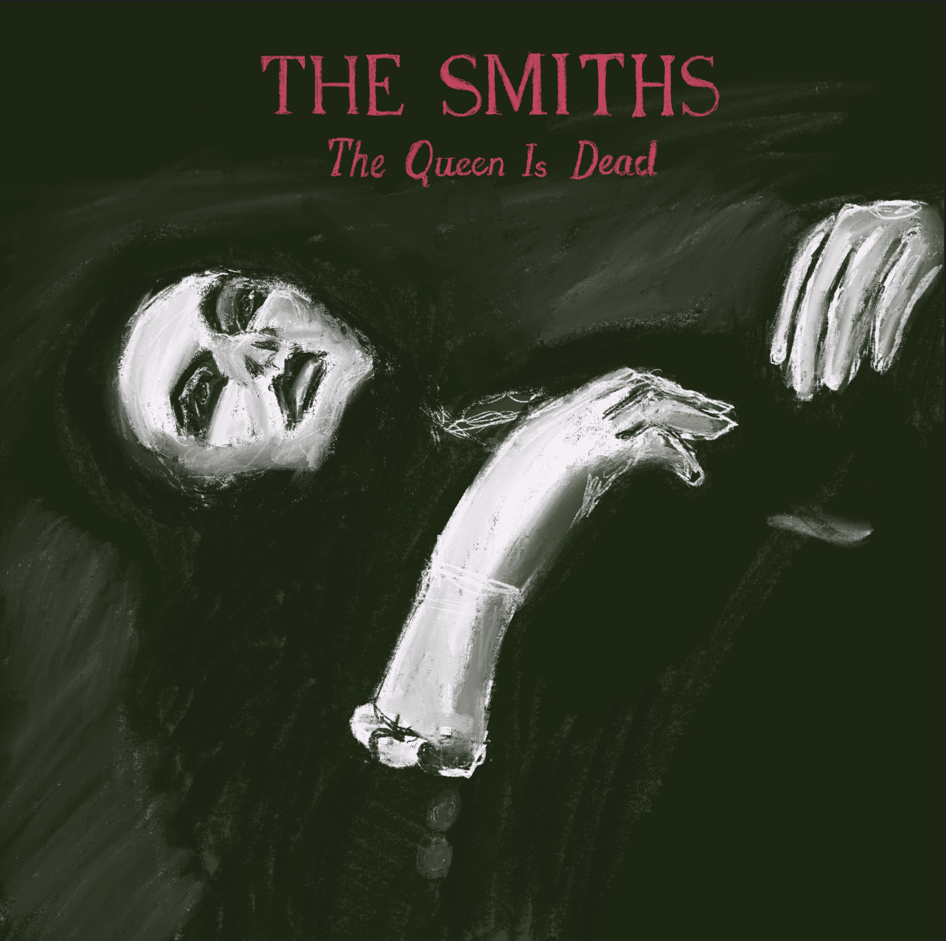
The Smiths – The Queen is Dead (or my leaning in to truly experiencing emotion in all its horrifying, embarrassing glory)
What a cosy vibe
In 2016, a strange thing happened. Having broken up with my boyfriend of four years, I was faced with a new enthusiasm for music.
I had certainly enjoyed music in the preceding four years. Only, it had to be music that didn’t cause me to think deeply about my feelings. I didn’t really know that I was doing this until after the breakup. Through no fault of anyone, the relationship had been flawed and I had been trying to avoid facing this truth for a long time.
In the Aeroplane Over the Sea was probably the only album I was really into during that time. I was also very into Kesha and songs from musicals (I’m really all over the map). But music about heartbreak or true love, or anything that threatened to pull me towards introspection, I pulled away from.
One dark November night, heading home from my then-boyfriend’s house, I passed a busker playing ‘Father and Son’ by Cat Stevens aka Yusuf Islam. He sang “I know I have to go”, and it unexpectedly penetrated my no-introspection armour. I began to cry. I knew I had to end things.
After the breakup, I finally shrugged off my mantle of denial and began feeling EVERYTHING. Including a giant crush on a colleague from the shop where I worked.
He had a really nice way of introducing me to new music. Rather than say “You should listen to Deftones”, he’d say “What do you think of Deftones?”, seeming to assume that I was already familiar with their oeuvre. When he asked me about my feelings for The Smiths, I didn’t directly lie, but I phrased my answer carefully.
“I really like ‘There is a Light’ and ‘Asleep’, and I also think ‘Some Girls are Bigger than Others’ and ‘This Charming Man’ are great”.
Translation: “I have listened to exactly four Smiths songs, and I have listed them herewith.”
Well. As my crush grew, so did my love for The Smiths.
To anyone who knew me at this time, I’m very sorry. It’s like when I got really into Monty Python as a teenager. In every conversation, I found a way to quote a Smiths song, or to tell someone at length about Morrissey’s lyrical genius. All I did was reference the Smiths for about two years.
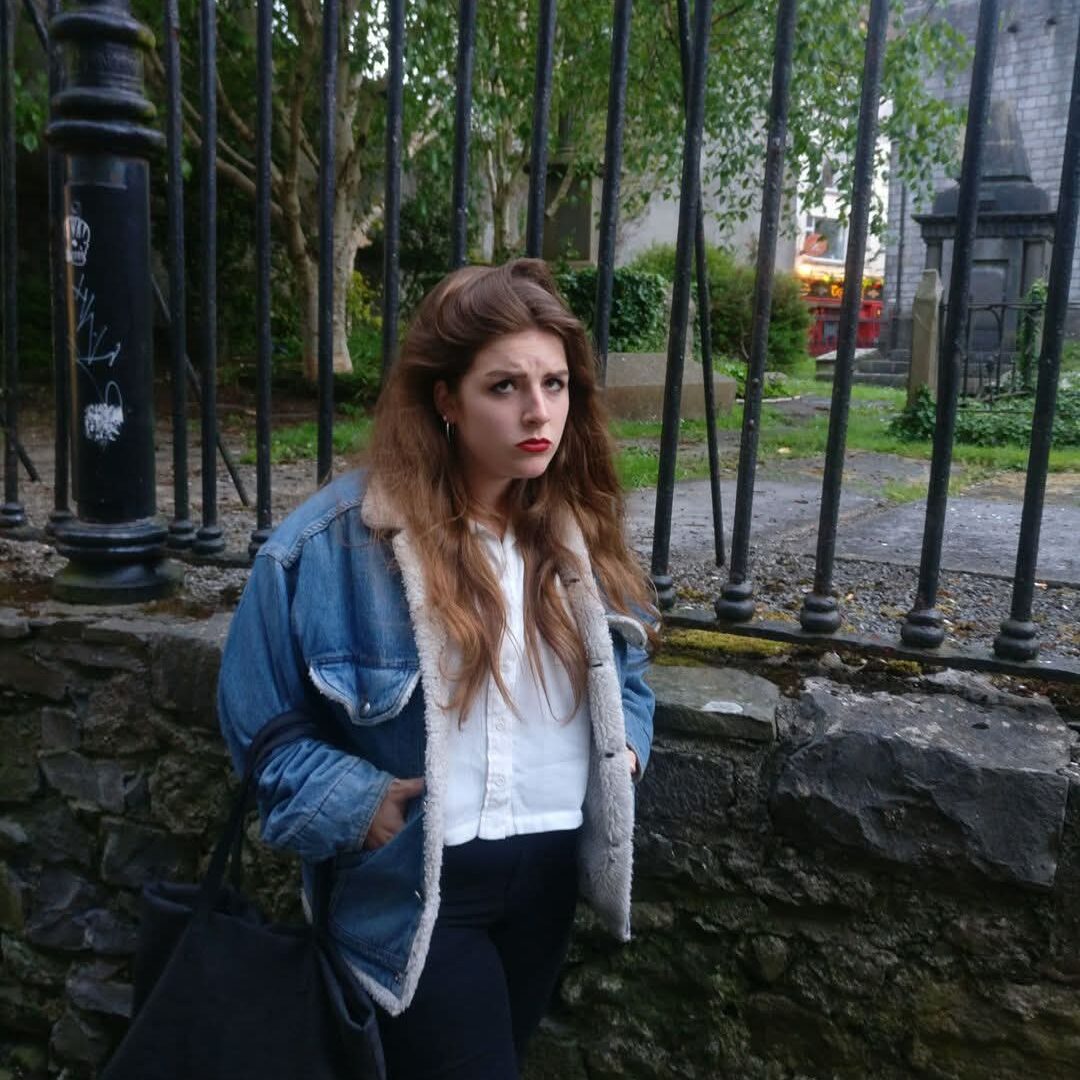
Why yes, that is me, having asked my friend to photograph me posing like Morrissey in front of a cemetery.
My entry point to a full blown Smiths obsession was The Queen is Dead. It has everything you want from The Smiths: petty grievances (‘Frankly Mr Shankly’), the dark creeping sense that nothing will ever work out for you (‘I Know It’s Over’), grandiosity masquerading as self-effacement (‘Bigmouth Strikes Again’), brazen pretention (‘Cemet’ry Gates’), camp (‘Vicar in a Tutu’) and probably the greatest anthem for awkwardness ever in ‘There is a Light that Never Goes Out’. There’s only one song that I don’t love on the album, and it may actually be the only Smiths song that has never hit for me at all (I’m someone who sincerely likes ‘Golden Lights’), and that’s ‘Never Had No One Ever’ which feels redundant and almost parodic (but not in a fun way) right after ‘I Know It’s Over’.
Re-reading the above paragraph, it sounds like I’m roasting the Smiths. That’s only because I relate so strongly to their work that I cannot help but imbue my writing about them with the same deprecation as I would use on myself.
Let me be clear: this album made, and still sometimes makes, me feel as if someone has scraped out the saddest corners of my soul with the fears I’d never dared to speak into reality, as if someone has found their way into my memories, as if someone knows the parts of me that are mean and defensive, and witty and smart, and then hopped into a time machine and recorded this album in 1986.
It’s just so funny and profound and smart-arsed. Favourite lyrics include:
“So I checked all the registered historical facts/And I was shocked into shame to discover/How I’m the 18th pale descendent/Of some old queen or other” – ‘The Queen is Dead’
“Frankly Mr Shankly, since you ask/You are a flatulent pain in the arse” – ‘Frankly Mr Shankly’
“It’s so easy to laugh, it’s so easy to hate/It takes guts to be gentle and kind” – ‘I Know It’s Over’
“A dreaded sunny day, so let’s go where we’re happy/And I meet you at the cemetery gates/Keats and Yeats are on your side/While Wilde is on mine.” – Cemet’ry Gates
“Sweetness/Sweetness, I was only joking when I said/I’d like to smash every tooth in your head” – ‘Bigmouth Strikes Again’
‘And in the darkened underpass/I thought Oh God, my chance has come at last/But then a strange fear gripped me and I just couldn’t ask” – ‘There is a Light that Never Goes Out’
The elephant in the room of any contemporary discussion of the Smiths is that Morrissey is horrible. He is mean, xenophobic and moves further and further right-wing as the years pass. If it is any comfort, he is not exactly winning any hearts and minds or attracting anyone to his worldview. He mostly just maintains a blog where he complains about everything.
Some people say it’s hard to believe he became this person, but I think Morrissey is what happens when you nurture a kind of internal otherness that rejects others before they reject you. His lyrics speak to sad parts of ourselves, or angry parts, or the l’esprit d’escalier feeling of thinking of the perfect insult long after you have the chance to use it. There’s liberation in that as a pressure release, but it’s no way to live.
The crush on the colleague, coming as it did alongside me becoming one giant nerve ending in the aftermath of my numb years, ended up being confusing and heartbreaking. That heartbreak though, it felt amazing. Every subsequent heartbreak, I would listen to ‘I Know It’s Over’, a kind of theme song for my disappointment. So self-indulgent of me!
But heartbreak is something I always remember to indulge in, a little bit, as a treat. I think of this particular heartbreak with fondness. It was so much better than feeling nothing at all.
Frightened Rabbit – Midnight Organ Fight (or when heartbreak gave me the album with which to get over it)
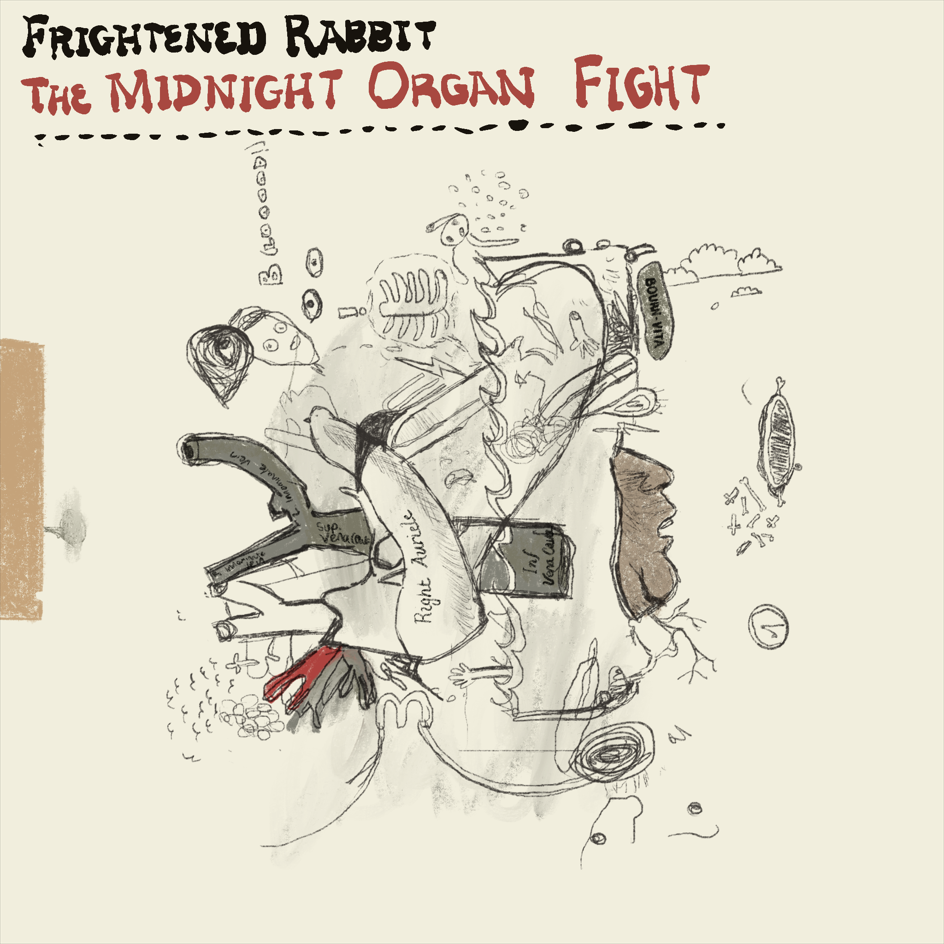
Drawing this was a trip.
I often look at my music taste in my twenties and realise how often I was influenced by the men I dated or was otherwise close to. Each of these entries is an album that a man “gave” me (of course, not literally, the cheap bastards). There’s probably something worth analysing in that (and to be fair to me, I have analysed that), but I do quite like the image of myself as a kind of palimpsest, becoming cooler after every dude I went out with. Engulfing and digesting their interests, expelling the ones that don’t resonate with me (I’m sorry – Car Seat Headrest has never hit for me, men) and keeping the things I really loved.
I had a brief relationship (what we now reductively call a ‘situationship’) in my twenties that had no right to be as influential as it was. By our third date, I had fallen hard. To be fair, our third date was a three-county, three-night, attending-his-friend’s-wedding extravaganza. By that stage of my life, I’d had a few painfully non-committal entanglements in the preceding years, and I thought the wanting-to-bring-me-to-a-wedding factor signalled an openness to a relationship. Rookie mistake, says every woman who was single in their twenties as they read this.
It was late the night of the wedding, in the hotel room, that he said “If I wanted a girlfriend, it would be you.” A dizzying, “here we go again”, end of a sitcom episode feeling overcame me . I imagined ‘I Know It’s Over’ would play at this point in a tv adaptation of my life, or perhaps be the theme tune.
By the morning, I had decided that I would keep seeing him, in the hopes that he would change his mind. He didn’t. I treated every date like an audition to be finally accepted as a girlfriend. He was probably in disbelief at how handy it was to have the Girlfriend Experience, minus any commitment or responsibility.
The relationship ended, a good bit after it should have, when he suddenly became very cold. Though harsh, it was helpful, because there wasn’t much that would have dissuaded me from continuing to date him otherwise. I clearly was willing to tolerate a lot of confusing treatment. Without this definitive end, I probably would have just kept on hoping that I would one day pass the test.
I later learned that “If I wanted a girlfriend, it would be you” was something he said to multiple women, often in very similar circumstances. It seems in his mind it was a very neat disclaimer, like at the end of a radio ad: “This man does not claim any responsibility for love that may or may not result from spending 72 hours in each other’s company. Any resulting psychic trauma should be directed to your GP for appropriate treatment. This man is regulated by the Central Man Regulator.”
Anyway, the guy had great music taste. Every time I fell in love with someone back then, my Liked Songs on Spotify quickly filled up with stuff they showed me. It’s to the extent that I can track who my love interest was as I scroll down through the list.
He introduced me to an album which ended up being the soundtrack of my getting over him: The Midnight Organ Fight by Frightened Rabbit.
Discussion of this album will also involve discussion of suicide, so trigger warning for that. I’ll add a little paragraph for when discussion of suicide concludes and when you can pick back up reading, if you choose not to read about that.
The Midnight Organ Fight by Scottish band Frightened Rabbit is an album with cult status, just like ITAOTS. It’s also got (to me) a deceptively twee cover. Indie albums with covers like that never really hit for me, but I was willing to give it a try.
Added this after I drew the cover to head this section: I was wrong, it’s actually full of details I never took the time to pick out before. It’s quite morbid but with a lightness of touch that matches the tone of the album pretty well.I think I actually just don’t like design from this time very much, and at a glance this one seems fairly typical of the era. It really isn’t, though,
It turned out to be anything but twee. It’s a collection of songs about depression, a disintegrating relationship, suicidal ideation and legacy. The album is wallowing, while making grim fun of itself for wallowing: “You must be a masochist/To love a modern leper/On his last leg” shouts Scott Hutchison on the album’s opening track, ‘The Modern Leper’. His voice is strong and emotive, masculine and vulnerable.
It’s also an impressive album, musically. It was only years later, listening to Billie Jo Spears’ ‘Sing Me an Old-Fashioned Song’ that I realised that Frightened Rabbit use the same strumming intro as a kind of reference to it in ‘Old Old Fashioned’. There’s a galloping, roaring energy to ‘Modern Leper’, ‘I Feel Better’, ‘Fast Blood’ and ‘Head Rolls Off’ which marries with some of the heaviest lyrics I’ve ever heard. The sound feels anthemic, triumphant, helping to lift the weight of the words and ideas within.
My favourite track is ‘Poke’. In it, Hutchison sounds raw, exhausted. It’s about a long-term relationship that has totally broken down. In it, he asks for physical pain to take the place of the emotional numbness: “Poke at my iris/Why can’t I cry about this”, and incorporates pet imagery to show how the companionship has been reduced to being akin to a useless cat or a dying dog rather than a life partner: “I might never catch a mouse/And present it in my mouth/To make you feel you’re with someone/Who deserves to be with you,” and “Why won’t our love keel over/As it chokes on a bone?/We can mourn its passing and then bury it in snow.”
There’s one powerful, beautiful image that shows the final remnants of their love: “But there’s one thing we’ve got going/And it’s the only thing worth knowing/It’s got lots to do with magnets and the pull of the moon.” This cosmic connection, almost twinning, now reduced to “I’d say she was his sister, but she doesn’t have his nose.” Witticisms like that, rather than breaking the tension, evoke the rueful laugh that one coughs out between sobs.
‘Head Rolls Off’ is particularly interesting. Firstly, because it starts off with the incredibly funny line “Jesus is just a Spanish boy’s name”. Irreverently, he goes on to talk about how it’s not morbid or unkind to be flippant about death, seeming to find comfort in pragmatism: “it’s not morbid at all/Just that nature’s had enough of you”. He invokes religious imagery again: “I believe in a house in the clouds/And God’s got his dead friends round/He’s painted all the walls red/To remind them they’re all dead.” It seems to make gentle fun of the idea of the traditional idea of heaven, that all of God’s preferred pals would be invited to some undead dinner party. The song seems to suggest that the afterlife that we long for could instead be the impact we leave on the world: “You know when it’s all gone/Something carries on […] While I’m alive, I’ll make tiny changes to Earth.” Hutchison sings about the cyclical nature of life: “When my blood stops/Someone else’s will thaw/When my head rolls off/Someone else’s will turn/Mark my words, I’ll make changes to Earth.”
Hutchison died by suicide in 2018. His friends and family founded a charity in his honour called Tiny Changes, which helps to provide mental health support to young people in Scotland. The cult status of Midnight Organ Fight also led to a cover album, which was originally set to release before Hutchison’s death but instead came out in 2019 featuring Biffo Clyro, Daughter, Aaron Dessner, Julien Baker and Lauren Mayberry, among others.
End of suicide trigger warning here. If anyone needs resources for support after reading about the topic, the HSE lists some resources here.
With all of that in mind, it feels small and petty to connect it to my little heartbreak. However, the album’s sense of making peace with doom resonated with me after the end of my relationship with this person. Looking back, all I saw were times I could have ended the relationship earlier to avoid the pain, but instead I kept going back in the hopes that the situation would change. This album helped me accept the fact that I’d treated myself so poorly.
It also gave me a new lens through which to view the ex-not-boyfriend. Rather than some amazing, infallible cool guy, the ‘modern leper’ image offered an alternative perspective: “Is that you in front of me/Coming back for even more of exactly the same/You must be a masochist/To love a modern leper on his last leg.” Yes, I was returning, time and time again, to be rejected and humiliated, but he probably had some bad self-esteem stuff going on too. It’s not like he was living the dream, with me the pathetic one. It helped me to take him down from the pedestal where I’d placed him, which did a disservice to both of us.
The gallows humour of the album was also really resonant for me, because, Jesus Christ, this situation had some very funny bugs. This guy was in a band, and fortunately I never listened to them while we were seeing each other, because by all accounts they’re really good. I can only imagine how much harder it would have been to get over it had I liked the music. After we ended, the band took off, and suddenly everyone I knew was talking about them, right when I never wanted to be reminded of his existence. The mania hit its peak when he featured on a LITERAL billboard was erected metres from my apartment. I had to laugh because, Christ alive, I was really not being allowed to forget this man.
So, yes, my funny doomed little horror of a relationship ended, but my love for this album full of its own doom, humour and horror lives on. I fulsomely thank this man for showing me Midnight Organ Fight, as well as some great songs. As for his own music, I’ve still managed to avoid it.
Thank you for reading! Please leave a comment if you have any suggestions for my next post, otherwise I’ll subject you to one of my personal obsessions. Which you’ll probably enjoy too!
I was going to call this list my ten favourite albums, but I felt they needed context, because how I feel about them is laden with caveats. Then, I realised the better story is in the caveats themselves. I have a lot of complex feelings about my music taste – there’s defiance, nostalgia and shame mixed in with a simple love for bangers.
I was also going to make this one post, but I found myself with too much material, so I will split it into two (or more) posts.
Before we get into this, I’d like to just thank you for coming to read this, and invite you to subscribe below if you would like my new posts linked straight to your email.
So, rather than I “here’s why I like these albums from a purely artistic and musical perspective”, here’s “the albums I have loved throughout my life and what they meant to me then and how I feel now”.
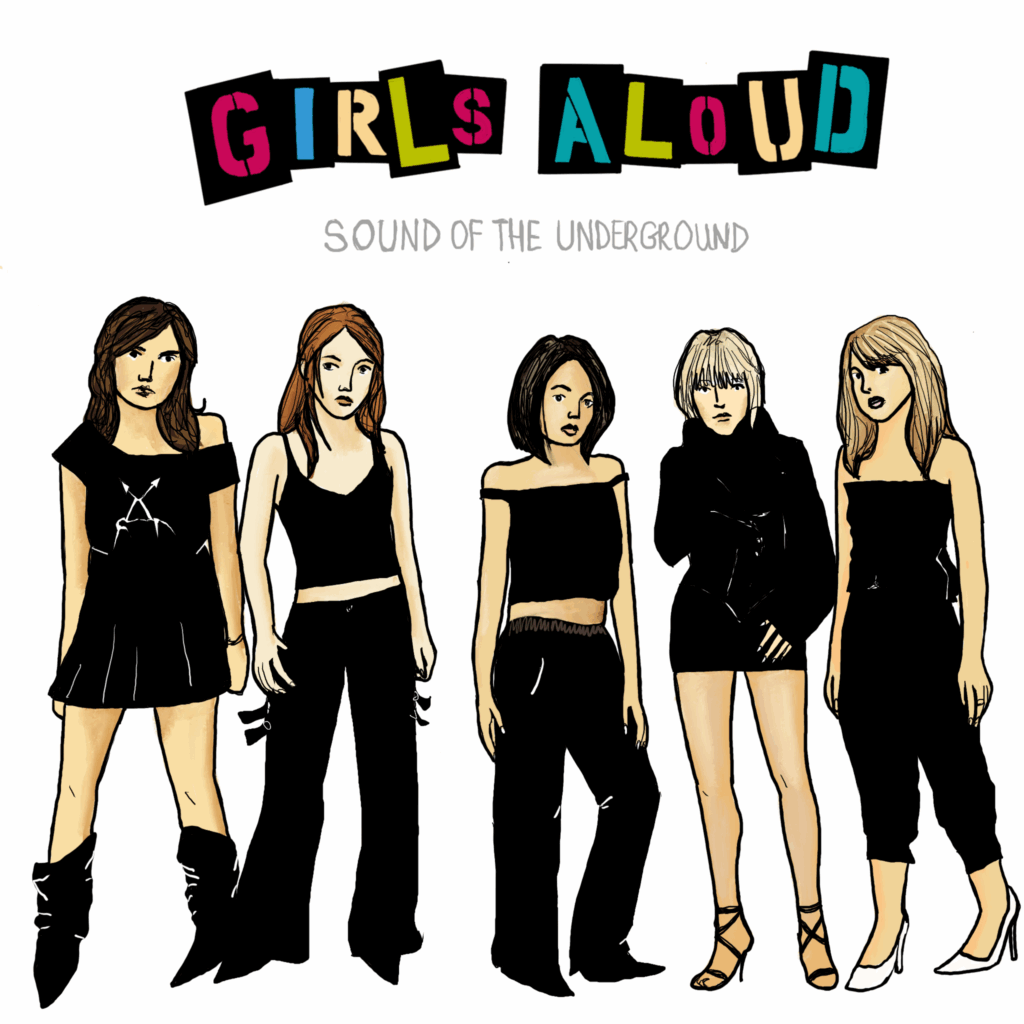
Girls Aloud – Sound of the Underground: The writer’s sincere beginnings
It’s 2003. I am ten years old, converting from a dedication to tomboyishness to a full and firm embrace of girliness. I am obsessed with watching Lizzie McGuire on TG4 and reading The Babysitter’s Club. Due to the constant plots with “cute boys” I am programmed into having lots of crushes. This onset of adolescence also encourages me, suddenly, to get into music. I poll my acquaintances, and Girls Aloud is a band that is having a moment.
I save up my euros and treat myself, eventually, to Sound of the Underground. Despite a glaring lack of experience in this area, I am transfixed by the depictions of “disco-dancin’ with the lights down low” and life getting “cold, it happened many years ago/when summer slipped away”. I had not even lived many years, but I certainly enjoyed angst even though I had yet to experience it. I had also been to London, so I felt I knew a thing or two about the Underground, thank you very much.
This ability to relate in strange, somewhat literal ways to songs exemplifies being that age, where experience is limited but you are still feeling very big things. Take “I’m With You’ from Avril Lavigne’s debut album. There’s a lyric “Isn’t anyone trying to find me/Won’t somebody come take me home/It’s a damn cold night/I’m trying to figure out this life/Won’t you take me by the hand, take me somewhere new” that hit me so incredibly hard, on a very literal level. We had found my cat, Scout, dead on the side of the road around that time, and in my mind the lyrics sounded like how I imagined her final moments. In retrospect it doesn’t really apply (she didn’t have hands, she wasn’t trying to “figure out this life” as much as she was trying to cross a busy road) but that was the first time a lyric penetrated in that way.
‘No Good Advice’ was Girls Aloud’s second single from SOTU, and it, alongside ‘Life Got Cold’, heralded my emo days to come. “I don’t need no bedtime prayer, cos frankly I don’t even care” snarled my idol, Nicola Roberts. As a child who regularly prayed, and felt a kind of compulsion to do so or risk inviting death to anyone I forgot to pray for, this attitude was intoxicating. So began a lifelong admiration for rebellion, tempered by my constant fears that doing so will cause me strife or loss. Unlike Nicola, frankly, I care a lot. But it feels amazing to pretend that I don’t.
On all car journeys, I petitioned for SOTU to be slid into the CD slot. What followed was 53 minutes of audio bliss, apart from one bit in “Some Kind of Miracle” where they sing “But my reaction is chemical/Somethin’ kinda sexual” where I would try to think of something to say loudly to my parents to drown out the bad word.
‘You Freak Me Out’ was another favourite of mine from the album, mostly because I loved the “woo”s. “WOO/You freak me out/I’ve got to scream/I’ve got to shou-ooh-ou-ooh-out” the ladies whooped multiple times. “My feet don’t fit in your sensible shoes/But you just won’t quit til you’ve killed my groove” helped to foster a healthy annoyance at my parents for not offering me more pocket money. Zero consideration for the potential ramifications that this might have on my groove, they forbade belly tops in perpetuity, pierced ears until I was twelve, and a mobile phone until I was 14.
A rebelliousness, albeit a purely internal one, is born.
Green Day – American Idiot: The writer gives up impressing men with her music taste
I wore out my patience on the janky hand, had nothing in the tank for the lettering, so let’s pretend it’s cute.
I’m walking past my brother’s room. ‘Holiday’ is blaring (‘blaring’ in my household meant audible from more than two metres away). My likely-embellished memory has me stopped in my tracks, slowly walking in, and saying suavely to him, “What…is this?” like a music executive in a film.
It’s American Idiot, by Green Day (“Green…Day? What is a ‘green day’?” I ask my brother. “I think it’s to do with when you smoke a lot of weed” he replies, faux-knowledgably. “Ah yes, weed” I faux-knowledgably respond). I am baffled as to why the song is called ‘Holiday’ as there is no mention of the seaside, or taking a ferry to France. It is my first exposure to music with a message, let alone an ambiguous message. A bit older now, it is a bit mad to think that the messaging on American Idiot could ever have seemed subtle to anyone, but I was probably about 11 years old, and not entirely sure what a government is. So it felt very grown-up to sing along to “Pulverise the Eiffel Towers/Who criticise your gov!-ern!-ment!” I wasn’t sure whose side I was supposed to be on, the Eiffel Towers (plural?) or the government. But it sounded very cool.
Hitting me at 11, this album, and the rest of Green Day’s discography, gave me enough to chew on until I was about 14. It also gave me the first lesson in boys and music.
I don’t blame my brother for this, as younger siblings’ admiration can feel mortifying to a teenager, but I immediately embraced and became obsessed with this album that he, supreme commander of cool, had deemed cool. This very quickly soured him on the album. I chalked it up to a sibling thing and perhaps a response to the sheer inescapability of my obsessions in our household.
At school, my Green Day obsession gave me a cool factor with the proto-mosher boys in my class. I traded CDs with my crush, then his best friend seemed interested so I immediately transferred my affections to him. We proceeded to “go out”. At twelve, this meant hanging out once over summer, kissing chastely on the lips exactly once until a devastating breakup in first year of secondary school (I would remain a “fridget” until I was 16).
Suddenly, this boy sneered at the music that I liked. Green Day, System of a Down… these had all been cool bands to him until we broke up. Then it went global: as girls all over the world began embracing pop rock and then emo music, all the non-emo (read: straight) mosher boys began to shit all over this genre.
I learned that lesson early and I learned it well – that music’s coolness to men will sharply decline if it appeals to women. So even as the long-haired boys in big hoodies sneered at the things I liked, deeming Green Day to be posers, I’m proud that from the start I always knew that the real posturing was from the boys who were afraid to like what the girls liked.
Don’t get me wrong, I still engaged in a lot of not-like-other-girlsing. I still tried to impress boys with my music taste and other interest, and to shit on things that were too girly. But I held a suspicion from then on, however privately, that male approval was capricious.
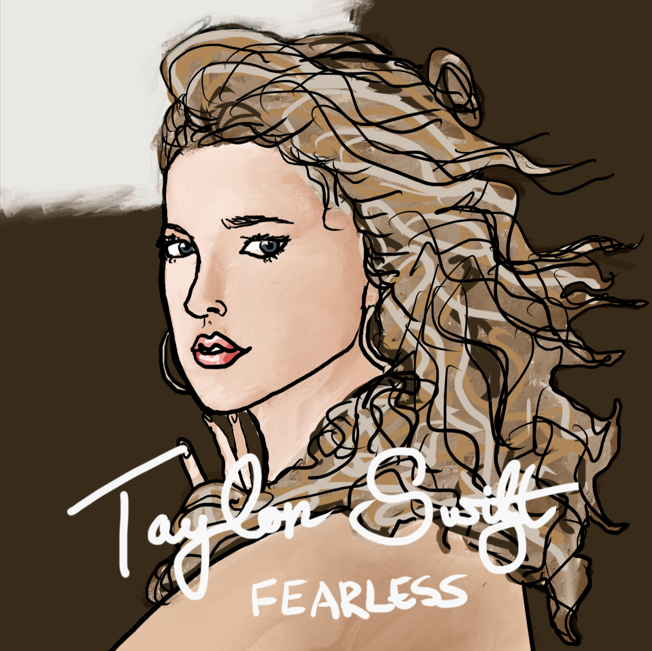
Taylor Swift – Fearless: The writer leans in to inciting disgust from men
If there’s a diss track on the next Taylor album about me for this monstrosity, it’s well deserved.
I’m glad to have had my experience with Green Day, System of a Down and even Dead Kennedys proving to me that boys will pretend to hate anything if they know that a girl loves it. I’m glad to have had this experience before I was introduced to Taylor Swift when watching YouTube at a friend’s house. As ‘You Belong With Me’ got stuck in my head and my teenage heart, I had thankfully already discarded the notion of a guilty pleasure. Here was an artist who wore her heartbreak and shame on her sleeve and turned it into success.
It felt a bit punk to me to openly adore this singer that seemed to get under boys’ skin – or at least certainly more genuinely punk than pretending to hate something I liked. Of course, in a way I was still feeling some type of response to how my male classmates felt about her, but it felt refreshing to acknowledge that response and feel exhilarated by it, rather than limited.
It was actually another mosher girl in my year, who had impressed me on the first day of secondary school with her thick curly hair and Ramones hoodie, who played us those first few Taylor hits on YouTube. In 2024, she and I actually attended the Eras tour together. In our teen years, she never felt her punk cred was diminished by her Taylor fandom, and she inspired me to be the same.
Taylor is also one of the few interests that I think my sister and I developed independently of one another. It’s as if we both woke up one day as Taylor Swift fans. Fearless is one of the last CDs that I remember playing over and over again. She’s the first artist where albums felt like incredibly good value (please note this is how it stood back then – I think her current modus operandi of releasing twenty thousand different variations of albums is predatory of her more parasocially obsessed fans).
When me and my sister got our hands on a new Taylor album, there would be two or three standout tracks immediately and the rest would be kind of a shrug for me. But next time I listened, there would be two or three more standouts. The album would open slowly to me, petal by petal, month by month, giving my teenage self a lot of mileage for the €15 I (or, more likely, my sister) had spent on the CD.
Fearless has the same charm as her first album, but it is already more mature. You see the constraints of the country dreamgirl already starting to wear thin as her anger and pain pushes through the upbeat songs. You get the sense that she is not a straightforward girl. She is wealthy, pretty, talented, but there is something warped. There’s a running theme, beginning with ‘Change’, and continued in subsequent albums (‘Long Live’, ‘Look What You Made Me Do’, ‘Anti-Hero’ and most notably in ‘Who’s Afraid of Little Old Me’) where Taylor seems to see herself as an underdog, fighting for acceptance, or even trying to accept that she is seen as a villain.
Rather than spin into a big tangent here about her most recent egregious attempt at “clapping back” at her “haters”, I’ll let Laura Snapes of the Guardian do it better.
All I’ll say is this – as an artist who’s made her career writing songs about her life, and often about how (specific) people made her feel, why can’t she let other artists do the same? And on that note, why does she dedicate an entire track on TTPD to shitting on a music journalist from back in her Nashville days? It is difficult for us to see her as the victim of bullying when she blows up every perceived slight to be a public spectacle, causing her fandom to relentlessly attack her enemy-of-the-hour.
She’s the biggest popstar in the world and she feels like she’s ‘a monster on the hill’. Perhaps she would feel less monstrous if she didn’t go on a rampage whenever she feels slighted. She thinks ‘Actually Romantic’ is coming off like a witty brush-off, a “why are you so obsessed with me?”, but it’s a lot more like Mr Burns calling to release the hounds.
To be clear, I don’t believe that Taylor is deliberately leveraging the sympathy of her audience to relate to a fake underdog image. I think Taylor has always felt out of step, wrong, off, disliked. Every time she is criticised, her reaction seems outsized because, to us, she is blatantly doing absolutely fine. But to her, every criticism makes her feel as if her deepest fear has been realised: that she was never really loved, or part of the gang, or accepted. I find the lyrics in ‘mirrorball’ to be incredibly telling and poignant: ‘I’ve never been a natural/All I do is try, try, try.’ This is what I find compelling about her.
I think this is what has always resonated for her fans. Taylor can make all the money in the world, but she has this feeling of wrongness and otherness that will always rear its head despite her successes. It’s like the feeling in primary school when you’ve finally been able to buy the cool runners that the other girls have, but when you wear them, the girls say they’re now out of style, or you’re try-hard, or you’re wearing them wrong.
These days, I find it hard to like her as much as I used to, because I find her selective mobilisation of her fanbase to be weird and vindictive. But I will always feel for her, and I think she is always going to write songs that resonate for me.
Despite my complicated feelings about her, I grew up with Taylor and her music. I look back with pride, not shame, at how I took an ex-boyfriend to task at the age of 17, sending him Taylor songs that I felt were relevant to our situation. That’s objectively quite embarrassing, and I did cringe in the immediate years following that, but today I’m glad I was emboldened to share my feelings, and not compelled to be cool to win him back.
Taylor taught me a lesson which still resonates today: it’s not embarrassing to try to be understood, as long as you act in complete sincerity.
Big thanks to my sister, for (A) going through these obsessions with me way back then and (B) proofreading this for me!
Next post: Cora learns to cry, and navigates her twenties – with the help of Neutral Milk Hotel, The Smiths and Frightened Rabbit.
I recently went to All Together Now, marking my third festival with zero alcohol or tobacco and my second festival with no alcohol, tobacco or drugs of any kind (I had a hilariously bad experience with a brownie at Another Love Story last year). Since quitting alcohol two years ago and smoking last year, I honestly thought that experiences like music festivals would not be the same, and the effort of going to one would be heavier than the potential joys I would experience.
I don’t want you to go into this article thinking I’m some joyless freak, who probably gets off on not doing anything fun. Let me rhapsodise briefly, because I really want to impress upon you how much I appreciate the joys of smoking and drinking, especially at a festival. There is nothing I can romanticise harder than lighting a rollie in a sunlit field, sitting on dry summer grass. Cracking open a can of beer as you begin that stomping trudge to the next stage. When you have a Deep Meaningful Conversation (DMC) with your best friends at 2am, lying under the stars and somehow avoiding getting stepped on by your fellow festivalgoers.
In recent years, these moments had petered out, even with alcohol and tobacco in the equation. I couldn’t stay awake long enough to get drunk enough to have a 2am DMC, but I could certainly get drunk enough that I battled horrific anxiety and sickness the following day (or two).
As for smoking, I began to notice that the romance of lighting a rollie was almost instantly extinguished after my first inhalation. The nicotine craving now quenched, all that remained was a dry throat and a bad taste. As I looked at the ashtray on my balcony, at all the half-smoked rollies, 5-10 per day on the balcony alone, I realised that I don’t actually like smoking anymore. However, there was more to that decision, as there was to my alcohol cessation (that story involves several days of diarrhoea).
In summary, I’m not a joyless freak, but I could no longer pretend that there was any joy in drinking or smoking for me anymore. I hate to be the one to tell you, but generally being alcohol-free is the best thing ever. If you’re wondering whether or not it has made me smug, it absolutely has.
So, those decisions brought me to All Together Now 2025 with no alcohol and no tobacco. What’s that like?
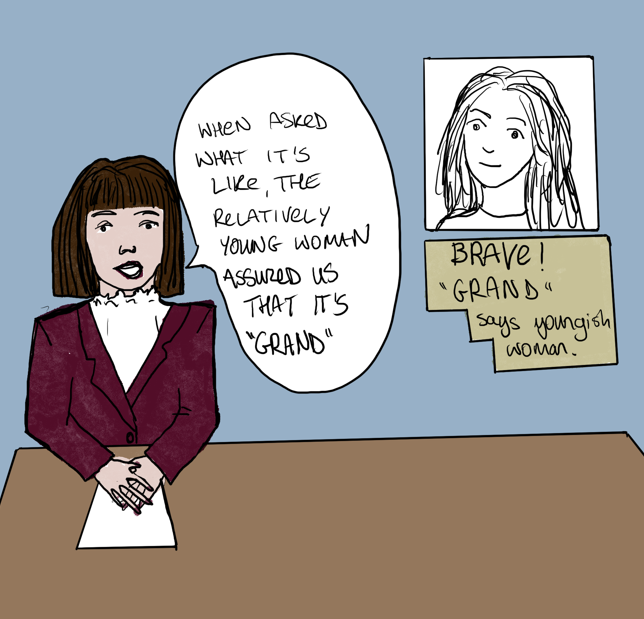
In short, grand. If you’re feeling generally grand, and if you enjoy festivals, then it’s grand.
Big if true!
One great thing is that being sober doesn’t stop you from being “Festival You”. One reason that people go to festivals to be released from their normal social inhibitions. They often assume, as I always did too, that this will require a bit of Dutch courage.
Most people are drunk or high, and so assume that you are as well. Their judgment is impaired, therefore you lose your fear of being judged. You can do your silly wavey dancing and show off what I referred to as “ass cleavage” (actually, more of an “underboob” equivalent, wearing a skirt short enough that the bottom of your cheeks is just about visible. “Ass cleavage” would be showing crack, and I’m too millennial to wear anything that isn’t high-waisted). Essentially, you get to be drunk without the hangover, and you can instantly snap out of it the moment it stops being fun.
Being sober is the best cure for anxiety, and not just for straightforward chemical reasons. When you’re sober, you can clearly see how little anyone else notices or gives a shit (in a good way) about you or what you’re doing. And, after a certain point in the night, you see how most people don’t seem capable of seeing anything at all.
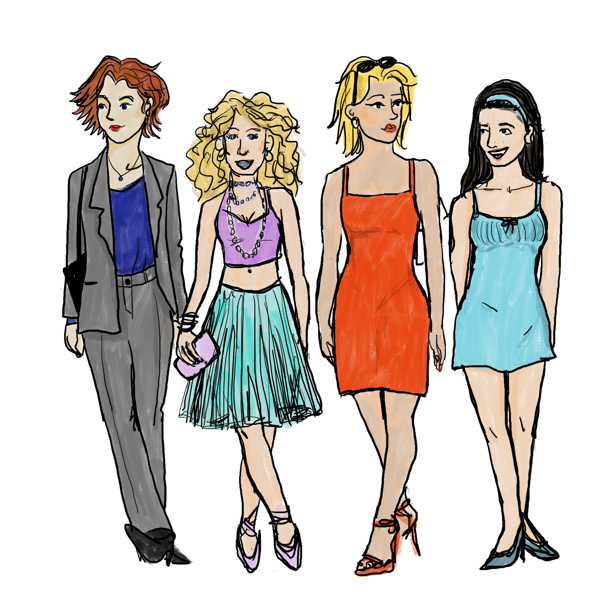
It’s a bit disconcerting, seeing hordes of beautiful twenty year olds with glassy eyes and legs like baby foals stomping towards you, clutching big cans in their tiny hands. You feel that, if you don’t dodge, they will bounce off your stolid thirty-one year old body and, before you know it, you have created a twenty-child pile-up. They will lie in their pile of jerking limbs, still staring with giant pupils, thinking they’re still stomping their way to see Bicep, until someone comes and untangles them. Or lads lads lads, in one great shoving mass. Trying for big man energy but they are striding for all the world like Carrie, Miranda, Samantha and Charlotte on the streets of Manhattan.
Turlough, Ferghal, Jack and Eoghan making their way through the festival
However, with the vast majority of your fellow attendees being totally legless, you realise that you could do all the things you want to without fear of judgement. For me, that involves taking my annual Wild Wee, barely visible among some trees. Dream big, you say? You’re underestimating how much I love an outdoor urination. And how long festival toilet queues are after 9pm.
All of that nice stuff said, there is a definite feeling of disconnect for the sober festival attendee. Because that thing about people not noticing or giving a shit about anyone else has a bad side (as you might have suspected).
Now, what a lot of people feel at a festival is togetherness, community. This festival is literally named All Together Now. To be fair, you do feel it sometimes. You feel it when you’re lying out at the bandstand, half-listening to the performer but mostly just dozing off in the sunshine with hundreds of other people. You feel it when you turn to the person behind you in the toilet queue to first roll your eyes, then loudly complain about the person taking upwards of ten minutes to take a dump or do a line of something, neither of which need to take ten minutes.
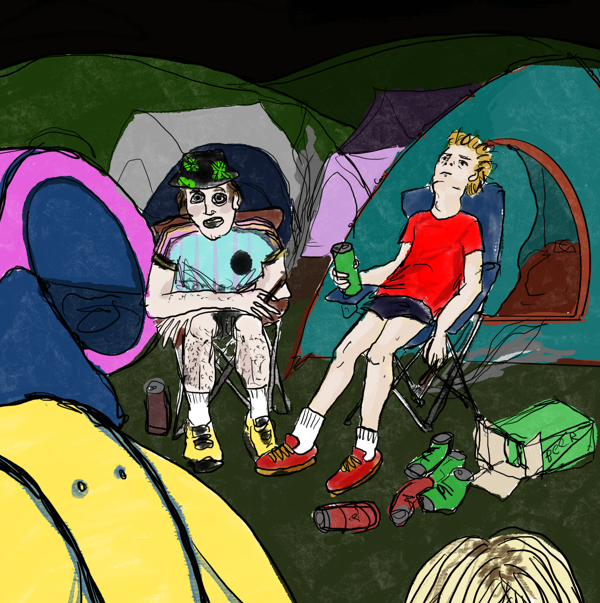
But you start to lose touch with your fellow man when you see that someone has taken all the fresh toilet roll out of the portaloos and strewn them on the grass. Or you pass the tent where shit music has tinnily been blasting for 12 hours, with five or six people sitting in a circle of camp chairs, near comatose except for a guy in a weed-patterned bucket hat who is almost shouting. Or the dreaded 11pm influx to the festival grounds of people who have been in those camp chair circles for the entire day, only now surging to see whatever is on, dead boys and girls walking. Now, that’s what I call joyless.
“AND THE THING IS THAT LIKE THEY LITERALLY HAVE TO TELL YOU IF THEY’RE A GUARD…”
Or, horror of horrors, the final morning. People clear out, leaving vast scatterings of rubbish in their wake. Tents, cans, waterlogged pillows, boxes, camp chairs, vapes. Fuck these people, fuck them five ways to Sunday and comfort yourself with the thought that the skag they are about to experience is worse than anything you’ve felt in years. These specific people are the worst, and if you’ve ever done this, I hope that you are suitably ashamed, turned your life around, and now volunteer with young people who are at risk of becoming as shitheaded as once you were.
But I’m being unfair to the vast amounts of drunk young people who do not leave their shit everywhere for someone else to clean up. The vast majority of these babies are good, normal people. My own personal baggage around drunkenness is mine and not theirs. I’ve noticed a puritanical tendency, even a compulsion, in me since I quit drinking, and a feeling of panic at the thought of inebriation that is certainly a sign of this being my problem. In short, these kids are triggering me.
One morning, I lay in my tent trying to nap as I heard a young lad approach the tent beside mine.
“Well lads what’s the fuckin’ storEEEEE!” came the voice. I rolled my eyes and got ready to listen, to try to remember all the heinous things that this young man was about to say so that I could repeat them to everyone for the next few weeks. What I heard instead was a pleasant conversation, and weirdly his chatting comforted me so much that I dozed off.
It’s clear that there is something addictive for me in judging these kids. Maybe it’s as intoxicating as alcohol used to be. Intoxicating in the sense that it stimulates me, and it poisons me. It makes me meaner, less charitable. In the tent, listening to the young fella, I stopped trying to be outraged by him. A comfort descended, soothing me to sleep.
As an aside, I remember once telling my therapist about two separate issues that were bothering me. One was that I was feeling incredibly insecure and felt as though people were judging me everywhere I went. The other was that other people were really irritating me, especially strangers, everywhere I went. My therapist brought me to the now-obvious realisation – if you’re spending all that time hating and judging others, you assume that they are doing the same to you. Your meanness towards others makes you mean to yourself. After all, you’re the only person actually listening to your internal vitriol constantly.
Two items on today’s agenda
What I see at the festival is a mob, off their faces and rendered totally antisocial. What I neglect to see is that this mass of arseholes is made up mostly of individuals who are temporarily messy, and who are not permanently these people. (TW: mentions of getting sick until end of paragraph) I have certainly puked at festivals (even as recently as my Another Love Story whitey, though I actually managed to get every single drop into a bin bag). In my twenties, I gurned and I chomped my jaws and weaved through crowds, bumping gracelessly into indignant people, pausing occasionally to chunder. What I remember about those messy times were the sweet strangers, often people in their thirties, who rushed over to pat my back and make sure I had friends or I knew where I was going. (End of getting sick TW)
This brings me to my biggest learning of the weekend. Perhaps it’s age and not sobriety that is the greatest contributor to my feeling of disconnect. Generally, people in their thirties and older do not have to spend too much time in the company or sharing the same resources as people in their late teens and early twenties. It really isn’t much fun having to do this. I find myself wishing there was some premium ticket where I could choose to be in a different plane of existence from twenty year olds.
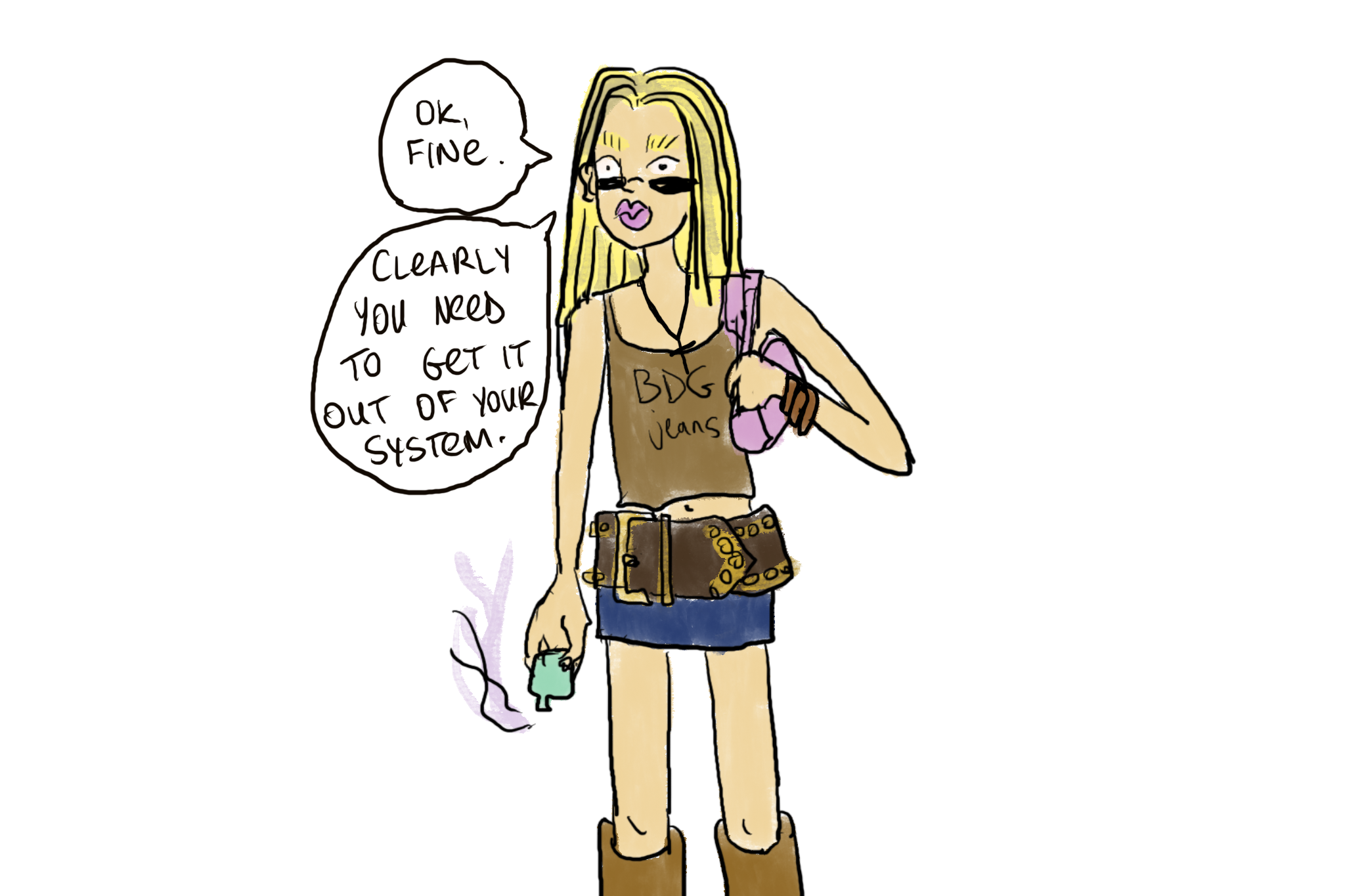
I had already had a taste of this intergenerational clash in June, at Charli XCX at Malahide Castle. On the train, two teenagers were charitably saying to one another “It’s nice that there are so many older people going to this”. They then began talking about who in their friend group would be “on the bag” at the concert (spoiler: most of them. Except “Aideen. Aideen never does coke.”). At the concert, it appeared that all of the infant worshippers of Miz XCX had been raiding Urban Outfitters. Bedecked in sunglasses that looked like something that would have come free with Sugar Magazine in 2005, with giant belts on tiny skirts, mixing their 00s references bafflingly (you can be boho chic OR you can be Playboy bunny on her day off in Von Dutch, you have to pick just one), these children thought they were the cat’s pyjamas.
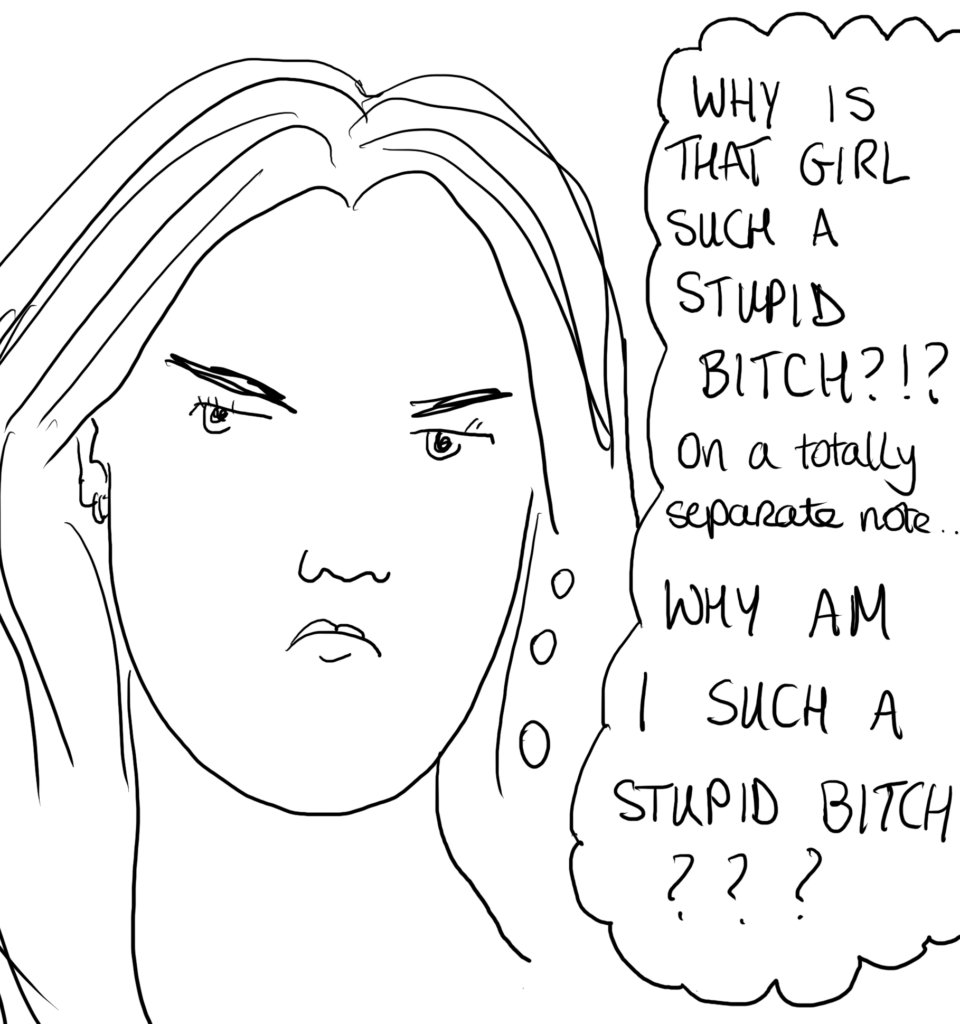
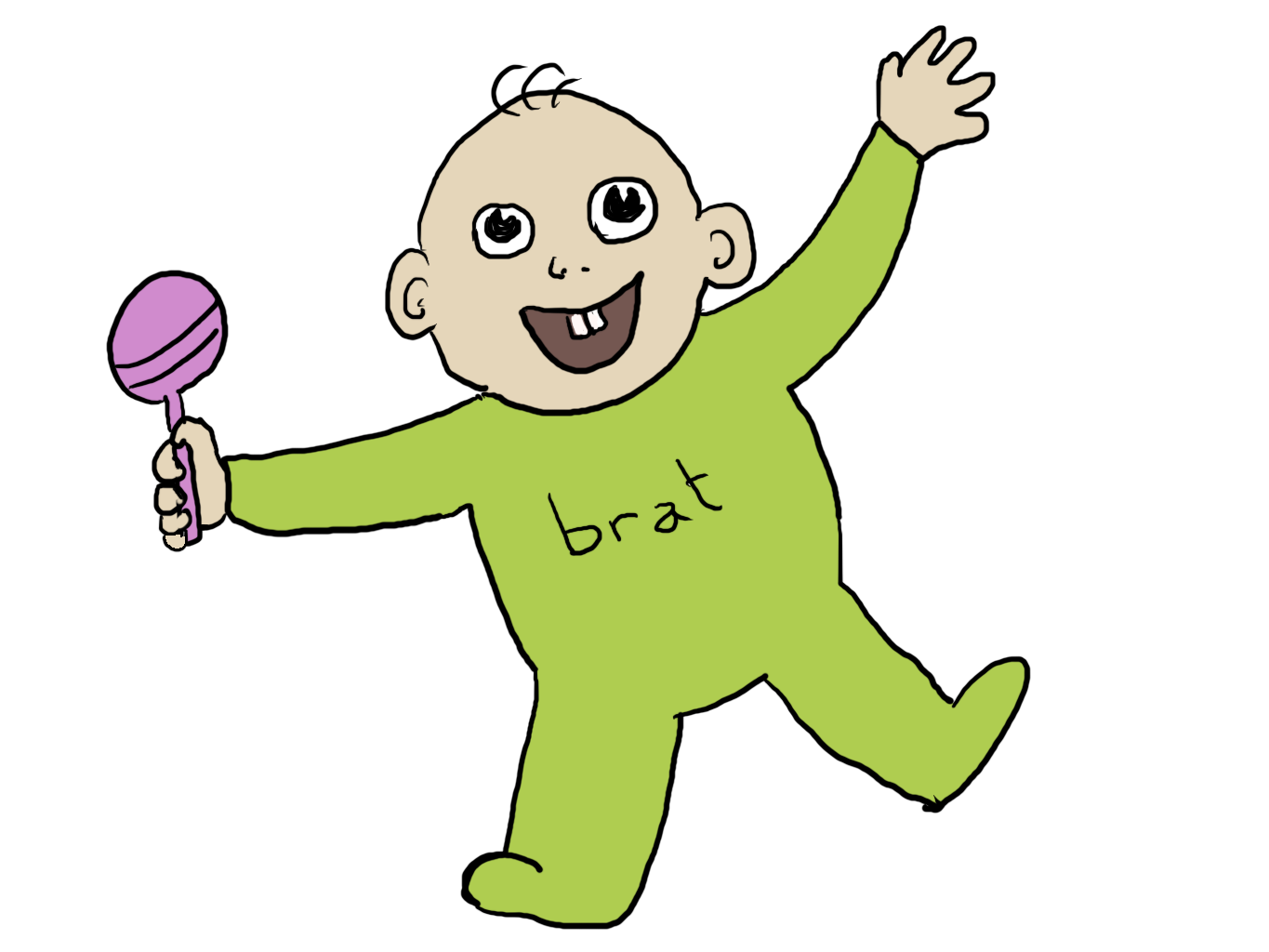
As Charli flung herself around the stage for an energetic hour, several what we call d’young peeple near us were unable to stand, and others were coke-ignorant of personal space. My bitter millennial brain had an epiphany: being brat is only subversive if you’re too old to really be a brat. brat is about the tension between wanting to grow up and wanting to stay young. It’s about liberating yourself from the maturity of this seeming next stage of life, unsure as you are to embrace it just yet.
A photo I took of one of my fellow Charli XCX gig-goers
A young person trying to be brat is literally just a brat. They stomp around in tiny skirts, thinking that they’re being subversive by being ignorant, when in fact they’re acting as God intended. Also, when discussing the youth, I keep invoking a God I do not believe in. I keep saying “God love them” or “God be with the days”. I never felt older than I did overhearing someone that night, as we surged through the crowds in Malahide to get the Dart home: “It’s giving queue.”
The age tension is the real difference here. Kids will overdo it, get legless, say stupid things. They also might not, but they will still be treated like a potential mess by the older people around them. Their elder festival attendees judge them to be drunk babies whether they are or not.
But this is not fair, and, young as these people are, they’re not idiots (or, at least, they have similar idiot-to-non-idiot ratios as older demographics do). They sense the underlying and sometimes blatant disrespect. I always sensed it. I remember, years ago, you’d get chatting to an older woman in a bathroom or a smoking area. They’d pretend for a few seconds to listen to whatever you were saying, then interrupt and ask your age, only to laugh ruefully and give you some shit like “Oh my God, you’re twenty-four, you don’t even know anything yet.” You are instantly dismissed.
I resented them because I had silently chosen not to judge them for their blatant out-of-dateness. I had thought that I should be chatty and respectful in a “respecting my elders” kind of way. Maybe they sensed that. Just as I sense it now, when a young person is very chatty with me. I feel my hackles raise slightly, at the thought that they think I need this.
We’re all just trying to protect ourselves. So here is my solution.
As an over-30-year-old, I hereby vow:
Not to act like your age is somehow an insult to my age
To see you as a distinct person rather than a “young person”
Please allow me to continue mocking your weird Gen Z/Alpha fashion.
The kids are all right.
Will all young people please vow:
Not to give me compliments solely because you think I’m sad to be older than you
To sometimes consider the volume at which you speak
I will allow you to continue mocking my weird millennial high-waisted clothes and matte makeup.
I’ll leave you with another moment that stuck with me from the Charli XCX concert.
That night in Malahide, as a train finally approached, a girl near me said, to the general agreement of her peers, “It’s giving train”.