Category: Social Media

  • Rage Bait

    Rage Bait

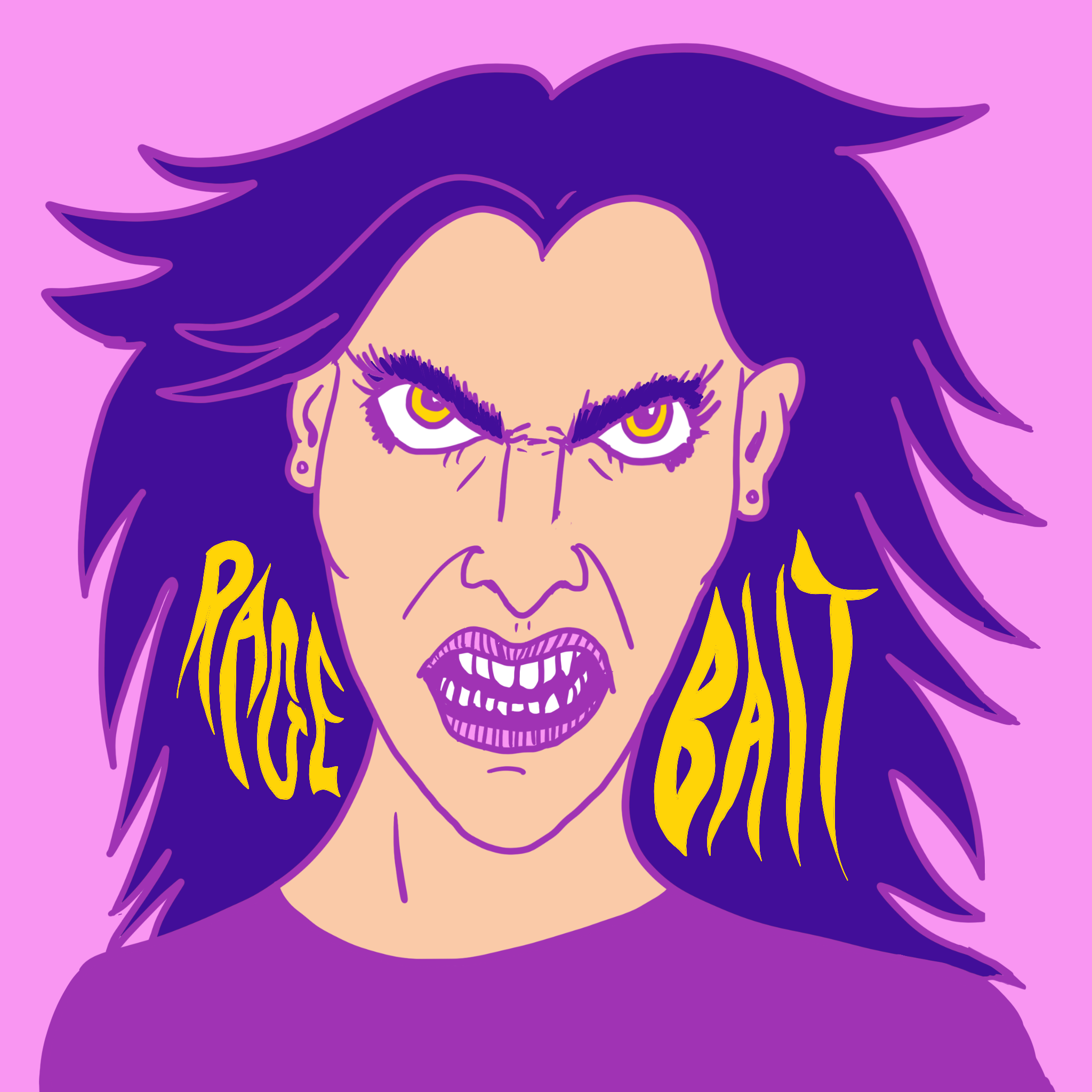
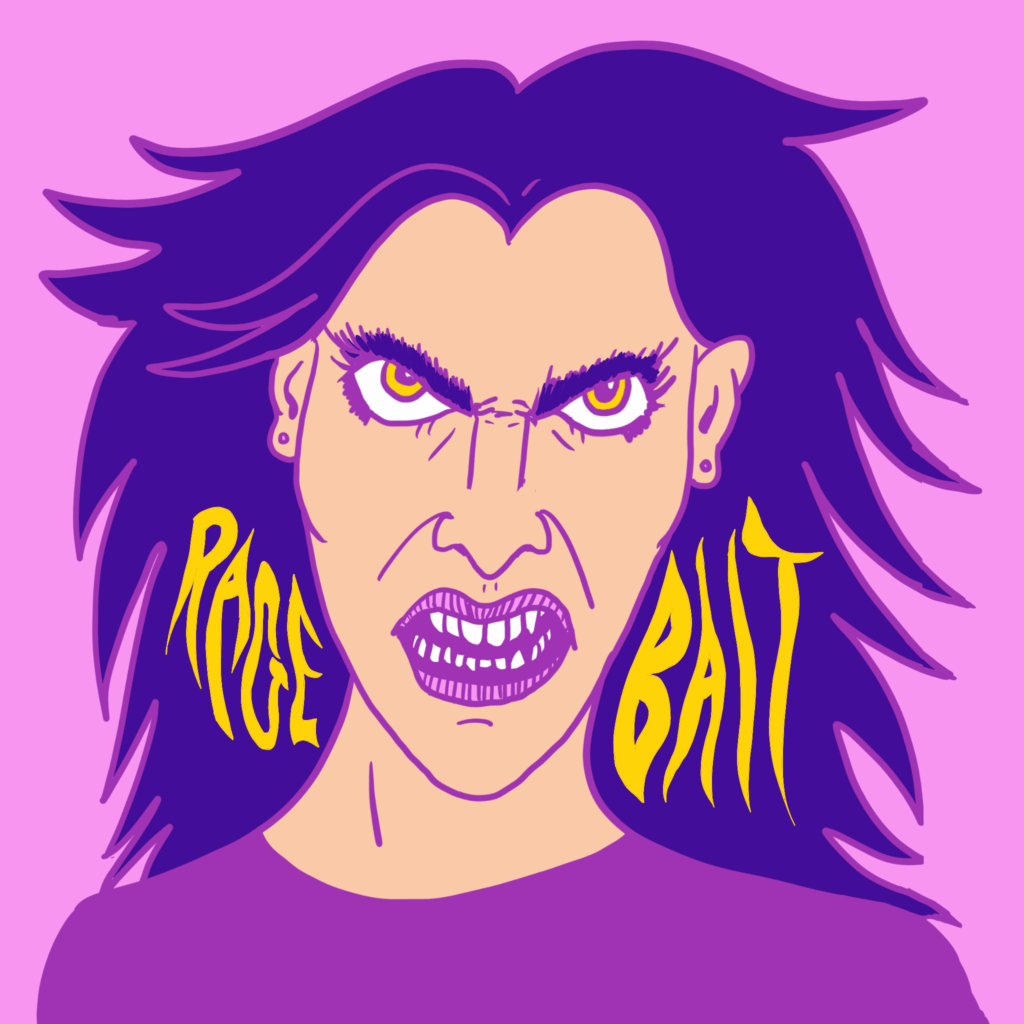
    A stylised illustration of a woman angrily snarling at the viewer. The words "rage bait" are in her hair.

    2025 is coming to a close, and the Oxford Word of the Year is “rage bait”. They define it as: “online content deliberately designed to elicit anger or outrage by being frustrating, provocative, or offensive, typically posted in order to increase traffic to or engagement with a particular web page or social media content”.

    We’re becoming increasingly aware of how our Internet diets are designed to make us unhappy, but this has been happening for some time.

    Let’s take a look at a case study. In 2018, Her.ie posted an article to Facebook entitled “Bringing home the bacon and similar phrases to be ‘banned’ as they’re offensive to vegans”.

    As I write this in the final days of 2025 as an intrepid citizen journalist, I await the banging on the door that will accompany the arrival of An Garda Síochána who will clap me in irons for my use of the phrase “bringing home the bacon”. We all remember those early days of the ban, when the people we loved were censured as they came home from work and innocently told their families that they had successfully brought home the bacon for another day. The children had been trained at school to report their parents for their language crimes.

    I’m aware of my impending legal woes for discussing this offensive phrase, but I want to talk about rage bait. And this is one of the earliest times I can remember realizing how fucked we all were.

    A drawing of some bacon on a yellow circular background. Written on the page is "Bringing home the [REDACTED]"

    Let’s look at the title of the article again: “Bringing home the bacon and similar phrases to be ‘banned’ as they’re offensive to vegans”. It’s pretty shocking. The phrase is “to be ‘banned’”, which implies that the banning has been decided. It’s happening.

    But which vegans made this call to outlaw “bringing home the bacon”? And what was their authority? How will it be enforced? Incidentally, this would all make a great Dead Kennedys song.

    According to the article, this all-powerful vegan mafia was headed by an academic, Dr Shareena Hamzah of Swansea University, who basically was part of a group which asked people to rephrase things like “take the bull by the horns” so that people might consider how embedded violence against animals is in our language. She wrote about this in an article for The Conversation. Her.ie, to its (only) credit, links to this article in their own one.

    Let’s read it. Let’s take a look at her rabid calls to outlaw phrases which are cruel to animals:

    “It may very well be that down the line powerful meat metaphors are eschewed.”

    “However, that is not to say that meaty descriptions will be done away with immediately – after all, it can take language a long time to change. And who is to say that even those who choose a vegan or vegetarian diet even want to do away with the meaty descriptions? It is interesting to note that a range of vegetarian burgers have been made to “bleed” like real meat.”

    OK, so, what she actually says, and I recommend reading the article, is that language might change as people become more aware of veganism and how meat consumption impacts the environment and the human body.

    Now, what Her.ie said to its audience is that Dr Hamzah, along with a crack team of vegans and the ghoulish PETA, were about to make one of the most momentous shifts in free speech in history, and people were about to be forced to stop using phrases that might imply cruelty to animals.

    In 2018 on Facebook, I watched, bemused and then frustrated, as people I previously considered to be fairly savvy chowed down on the bait, commenting on or sharing the article.

    “Fuckin ridiculous, can’t believe what the vegans are up to now”

    “I’m going to eat five burgers now cos fuck this [string of laughing-crying emojis]”

    Her.ie, which we then innocently still saw as a somewhat reputable news outlet, raked in engagement and therefore profit. Idiots everywhere worried that their beloved “bringing home the bacon” phrase would soon be wrested from their thirsty vocabularies. Some, presumably, ate more le epic bacon in order to protect free speech. I’d love to see the stats on how many Ron Swanson gifs were deployed.

    All because one journalist (and I wouldn’t give Her.ie the credit of saying that they broke this story) somehow found themselves reading an academic article and saw a way to get their editor off their back for another thirty minutes.

    In the intervening years, Her.ie devolved further and became essentially an advertising system for Penneys. There was a solid three years where the journalism amounted to: “You can now buy a mug of Chip from Beauty and the Beast. Umm, where do I sign up? Thank you Penneys!”

    Anyway, now it’s 2025. Rage bait abounds.

    Sydney Sweeney’s body became the unlikely site of a political battle, as weird MAGA people declared her breasts “the end of woke”, accusing the left of being upset by her femininity. Nobody is sure why this happened. Maybe one of the millions of monkeys on millions of typewriters on X said something about it, then Fox News covered the tweet, and now the left are being accused of being upset.

    That’s how news is made now. Someone who may not exist says something on the Internet, someone replies to it, and then Fox News covers it and pays an actual person to come discuss it on tv, and suddenly there are articles that Sydney Sweeney’s breasts are the “end of woke”.

    Sweeney then does a “jinnz” (“jeans” in Sydney-speak”) ad which has some thinly veiled white supremacy (“whaaat siprem’cy” in Sydney-speak, presumably), and we rise to the bait and discuss it endlessly, and now we’re actually mad at Sydney Sweeney when it’s a lot healthier to ignore her. Of course, if we had ignored it, it wouldn’t matter because someone somewhere would still have tweeted about it and then Fox News could have covered the outrage anyway.

    Bot accounts flood r/AmITheAsshole and other subreddits with fake stories they made on ChatGPT which cause the commentariat to dissolve in fits of horror. We are served a diet of our favourite strawmen, confirming our favourite prejudices. Fatphobes’ jaws drop as they read a fake story where a fat bridesmaid demands the bride pay her because her dress was uncomfortable, even though she insisted she was four sizes smaller than she really is! Men’s rights activists simmer with rage as they read a fake story where our reasonable male protagonist is accused by his wife of being abusive because he forgot their anniversary! Feminists feel that all-too-familiar red wave as they read a fake story where a teenage girl asks if her boyfriend is right that she would only be deserving of love if she gets a boob job.

    All of our beliefs are confirmed, and we feel that tug in our stomachs that always accompanies those moments on the Internet when we feel like there’s no way things could get any worse. The account that posted the fake Reddit story now has enough Reddit clout to be sold as a promotional bot to a beauty company who wants to trick r/MakeUpAddiction users into buying something, or used as part of some evil astroturfing campaign paid for by a Hollywood domestic abuser.

    Content mills used to churn out unrealistic cooking videos, but now they churn out utterly implausible or messy tutorials which enrage their viewers. A waffle is covered in marshmallows before being burned. A disembodied hand pours paint on a cake. Someone puts a fork in a microwave and, when it comes out, it’s a brownie. The content mills doesn’t care if children put forks in microwaves as a result. What they want is your attention and anger.
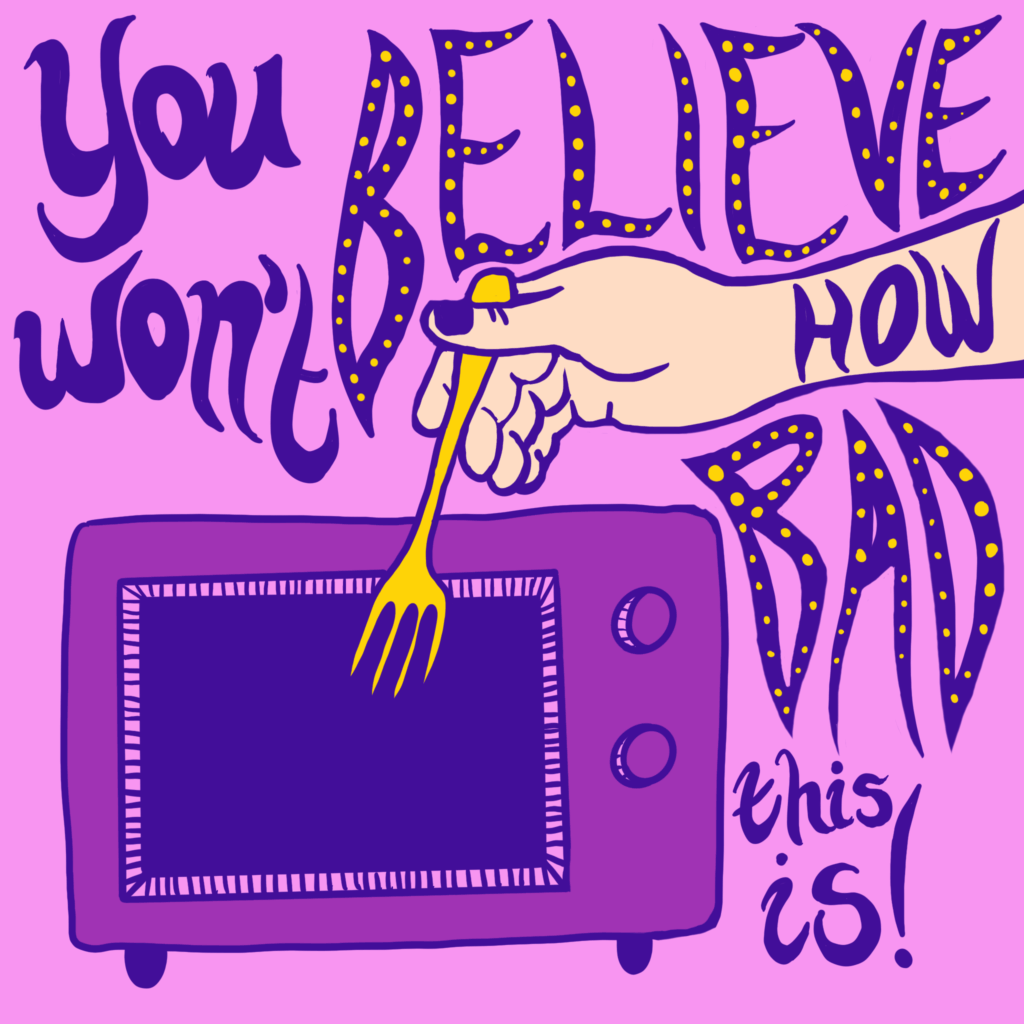
    A drawing of a hand holding a fork in front of a microwave, with writing saying "You won't believe how bad this is!"

    Artificial intelligence slop and just regular low intelligence slop floods Instagram reels and, presumably, TikTok (I wouldn’t know, I already have enough shit that keeps me tethered to my phone). We’ve stopped calling things vlogs or skits – it’s all just content. The most that we can say with certainty is that it is a piece of media, a thing, content.

    One of the most irritating types of content that has emerged is someone filming themselves dancing in the audience at a concert, then posting it on TikTok/wherever. They caption it, saying something like “not me being bullied by a stranger at the Charli XCX show”, zooming in on some randomer behind the dancing person who looks unhappy or annoyed. Maybe the person has a resting bitch face. Maybe the person is tired of people in front of them blocking their view with a fucking phone. Maybe the person is extra tired of this when the person isn’t even filming the artist, but instead filming themselves dancing, and now the person is in the background of this video. The video is uploaded, users flood the comments, accusing the background woman of not being “a girl’s girl” or accusing the TikToker of being a brainless attention seeker who is deserving of hatred from fellow audience members. All of this attention, good and bad, gives this TikToker their much needed attention (which is now currency) and they will now gain followers or be favoured by the algorithm. The woman in the background is collateral damage.

    It infuriates me. One, it infuriates me that people do this at events. Two, it infuriates me that people are stupid enough not to see through this. Three, it infuriates me that it infuriates me. I have given away my emotions, knowingly, for a tech company to make a profit. I have contributed to a culture which increasingly diminishes our ability to distinguish stunts from reality.

    A lyric from Rent often occurs to me. It’s about as subtle as a brick, but it made my teenage brain explode when I first heard it.

    The characters, Mark and Roger, are briefly abandoning their more bohemian lifestyles in favour of stability. “So I own not a notion/I escape and ape content/I don’t own emotion/I rent!” It was resonant to me, how the concept of ownership is applied to one’s emotions.

    That’s what comes to mind when I think of how it seems we are unwillingly, and often unwittingly, selling our emotions. Unlike Mark and Roger, who feel inauthentic and as if they don’t really feel how they do, we own our emotions. But we squander these emotions and the energy behind them , often in the service of deep political division, to line the pockets of the very billionaires who have inspired this outrage in us.

    But what can we realistically do? We can’t stop the outrage machine because, as I’ve said, Musk’s shitfarm X can always manufacture some outrage to serve the slop media so that they can make a story out of something. And even if we stop being outraged, some of our friends are gullible and genuinely thought that vegans were going to ban the phrase “bringing home the bacon”, therefore it’s fighting a losing battle to try to stop people getting riled up by stuff that they read online.

    What I think we can do is cease contributing to what we have decided to term “discourse”. If it’s stupid, let it be stupid. Over there.

    Of course, there is value to discussion, to pushing back if someone says something out of line. But pick your battles. At this stage, I try only to discuss things with people whom I believe are arguing in good faith, and whom I know to be actual humans. Don’t spoon-feed your best shit to a bot so that it can train itself to be even more offensive.

    Try to disconnect from your favourite sources of rage. Leave any subreddit that causes your heart rate to rise. Stop watching reels that are stupid. If you ever feel the need to comment, write the comment, then erase it and move on with your day. Your anger has power that you can use, don’t give it up for free to some freak billionaire who probably hunts human for sport.

    Thank you for coming to read this, and I invite you to subscribe below if you would like my new posts linked straight to your email.
    Subscribe

    Intuit Mailchimp

  • “Skinnily, I sadly and hotly…” A self-indulgent five-year retrospective on my brief Twitter fame

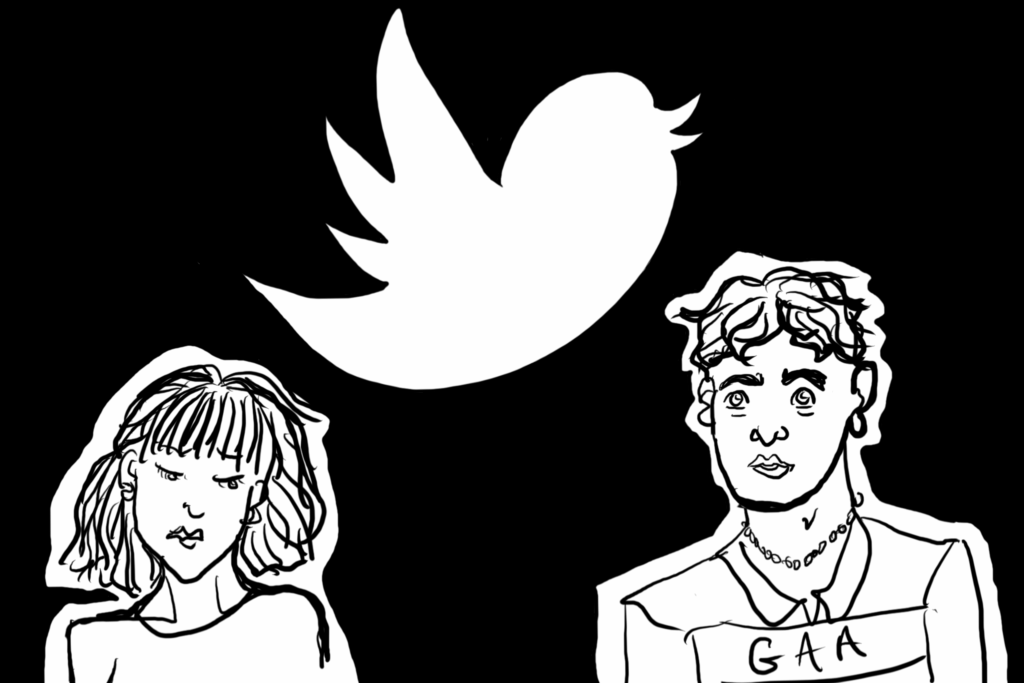
    A quick sketch of Connell and Marianne from Normal People. He is a handsome man in a GAA jersey which I have simply labelled "GAA" and he is wearing the iconic gold necklace of his actor, Paul Mescal. Marianne sadly looking down, with her hair in a messy bob with a fringe. Between them is the Twitter logo of old.
    Please excuse my lack of interest in realistically rendering a GAA jersey.

    On 24 July 2020, I was walking to St Stephen’s Green for a Tinder date. To set the scene – Taylor Swift had just dropped folklore and it was about to lash rain. Before leaving the apartment, I had rattled off a few tweets summing up my feelings about Conversations with Friends and Normal People. I had recently read Conversations and was in the process of reading Normal People. I had never seen the TV series. I still have not. Unbeknownst to me, I had caught the Rooney zeitgeist at exactly the right time.

    As I waited outside the gates of the park, I noted that a few people I knew who didn’t normally retweet much had retweeted me, with great enthusiasm. Then their friends joined in. By the time I was sitting down on the grass with my date, the thread had well and truly popped off on Irish Twitter.

    Before we get into this, I’d like to just thank you for coming to read my first blog post, and invite you to subscribe below if you would like my new posts to go straight to your email.

    Subscribe

    Intuit Mailchimp

    Here is my famous Twitter thread:

    I stared at Emma. She was talking very loudly and I could tell Joseph was attracted to her while also despising her. I visualized throwing wine at her but instead I poked my hipbone into his side and raised my eyebrows. He fingered me in silent agreement.

    “in case you hadn’t noticed, Joseph, I’m flawed. I’m not like Emma with her humour and her obnoxious breasts. Sometimes I think the only think I’m good at is cumming vaginally. And writing.”

    I don’t know why I go to parties anymore. Everyone just talks about refugees and human rights while playing soft jazz. I feel at nineteen we’re all too old for that. I stood there awkwardly in my very flattering black negligee that I’d paired with a beret from Urban Outfitters.

    Where’s Bronagh tonight? I couldn’t keep the edge out of my voice. Politically, I love other women but in practice it’s hard. She’s home for the weekend in Meath, he laughed humourlessly. I wish I could go home for the weekend but it’s harder when you’re from the west, I sighed.

    The doctor slammed my chart down. Tough luck, lady, he smirked, your womb is no bueno. Wait I can’t parody this cos it’s way too close to the truth of women’s healthcare and I really like how she represented that.


     A few initial thoughts:

    I’m pleased to see that it’s still funny, five years later.

    I’m particularly proud of “He fingered me in silent agreement”.

    I enjoy how you can see my date was probably at 14:30/15:00 and that I then took the thread back up the following morning to crank out a couple more jokes. Remarkable restraint, as all I wanted to do that day was continue making sweet love to Twitter.


    Now to the deeper musings.

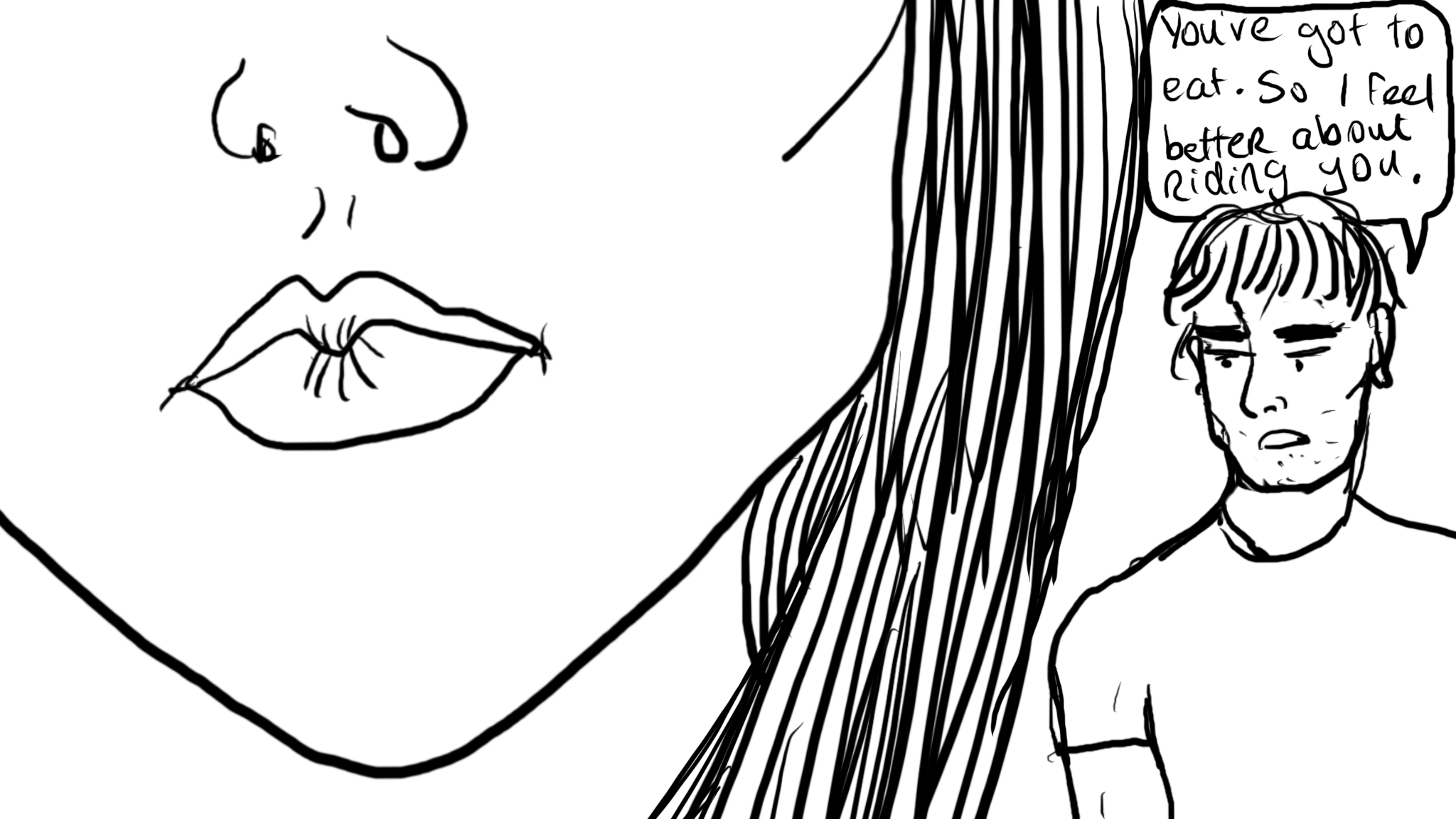
    The lower half of a woman's face. In the background, an attractive man is saying "You've got to eat. So I feel better about riding you."
    Feminist icon “guy who feeds woman”

    Most of the main female characters in Sally Rooney’s works are thin, and it is made explicitly clear that they are. Now, Rooney is not at all the worst offender for compulsory skinniness in main characters – it tends to be the norm. Predictably, heroes in fiction tend to fit into societal beauty standards.

    But I can’t help thinking that Rooney is deploying a writing trick where, if you want your character to be fucked up in a sexy way, make them someone who frequently forgets to eat, who simply doesn’t even have time to remember their own health.

    Seldom do you have a heroine who overeats due to stress, or who doesn’t have time to plan to eat in a more healthy way, unless the novel is explicitly about the main character being overweight. Even then, quite often these are Bridget Jones-type heroines, kooky and messy and cute, but always striving for thinness (spare a prayer for teenage me, reading the weights that Bridget would note at the start of her diary entries as being heavy when they remain unattainable for most women).

    No Bridgets in the Rooneyverse – you’re sad and thin and that’s that. Bigger people must not exist or must not feel things to the same intensity as the Rooney women do, or they would be too depressed to overeat.

    Writing this, I was worried that I am being too hard on the Rooneyverse, and that maybe some of this is hypersensitivity on my part, but this Vogue article from 2024 convinces me that this criticism is not just projection of my own body image insecurities. (Also – apparently in Beautiful World, Where Are You someone rubs “the fin of someone’s hipbone”? Jesus Christ, I would’ve dismissed that as overdoing it if I’d come up with that). These sad, fragile women with extremely limited caloric intakes make the reader feel as though being depressed will make them slender, make them catnip for very sexy men who will, every so often, make them eat but in a horny, controlling, BDSM way. The following day, it’s back to the usual diet of a glass of water and a paragraph describing one’s own clavicles.

    The “Emma at the party” section of the thread deals with a few things. The hipbone of it all, which I have already discussed, but also the collision of supposed awkwardness with the absolute narrative certainty that is always present that the main character is hot, don’t worry. Rooney heroines are never comfortable in themselves but are always sexy. Sexier than the men’s actual partners, and smarter and meaner too.

    However, you can read the meanness as important character flaws for these characters, rather than an endorsement of their mindset by the author. I find criticising characters for their explicitly bad traits to be an example of media illiteracy in action. “Patrick Bateman is such a misogynist!!!” Yes, babe, that is the point!

    Am I doing this? Am I depriving Sally Rooney of her god-given right to write horrible people? Why does the characters’ meanness annoy me so viscerally?

    I think this is a “me” problem. I’ve always disliked when women in novels seem to hate cheerful, sociable women. Women like the Emma from the thread. These women are funny and loud and large, and, to whatever extent that I project this, heroines in fiction are always waifish and only funny in their silent inner monologue. They would never be so vain, so excessive, as to make loud jokes or be fun at a party.

    I see myself as the opposite of a Rooney heroine. I used to visualise myself in social situations as if I were one of those barwenches in pirate films, bawdy and ruddy, or an innkeeper’s cheery wife in Victorian London. I’m always imagining some Rooney-esque woman skinnily and hotly hating me. In a way, me and heroines like Marianne and Frances are natural enemies, but that doesn’t make the writing bad.

    But take another book where a slim main character spends most of the book skinnily and hotly hating people. I adored Boy Parts by Eliza Clark, and the antihero Irina is very mean and extremely toxic (spoilers ahead, and trigger warning for some topics that touch on eating disorders). Boy Parts takes pains to note how Irina fits and even exceeds female beauty standards, but it reveals that Irina has undergone cosmetic surgery, exercises constantly, wore a waist-trainer for years and lives on undressed Tesco bagged salad and wine.

    The book takes pains to show how very small Irina’s life and her aesthetic joys have become in pursuit of this standard. She begins to feel a kind of obsessive anxiety when doing anything she enjoys, linking it mentally with the loss of control she associates with eating substantial food.

    (end of TW) Boy Parts is a rare example of a book that mentions how unhealthy the pursuit of beauty standards is while not making it the entire point of the character, or making it a book explicitly about body image. Her dislike and distrust of others is also slowly revealed to be much more about her than about them.

    Maybe I’d enjoy Sally Rooney books more if they were horror stories?

    I think, whether it’s worthy of criticism or not, what I find when I read about Frances or Marianne is that they seem to think that they are the only sentient and meaningful people in the room, and I don’t know if the narrative pays this off in any effective way. To me, they’re Chekov’s asshole, except at the end they don’t go off, they just anticlimactically roll onto the next thing life has in store for them.

    Finally, I’m a bit embarrassed at the “cumming vaginally” part. I basically lifted the joke from the song “I’m So Good at Yoga” from Rachel Bloom’s incredible tv show Crazy Ex-Girlfriend. What I wanted to represent was my annoyance at how very easy sexual satisfaction was for these otherwise very complicated characters (though I’m trying to remember if Frances experiences a lot of pain during or after sex? So maybe that’s not entirely fair). It used to irritate me when I read Fifty Shades of Grey as well, how Annabel/Christiana/Bella (??? I will now Google her name…) ANASTASIA STEELE would have an earth-shattering orgasm if Christian so much as raised an eyebrow at her nipples.

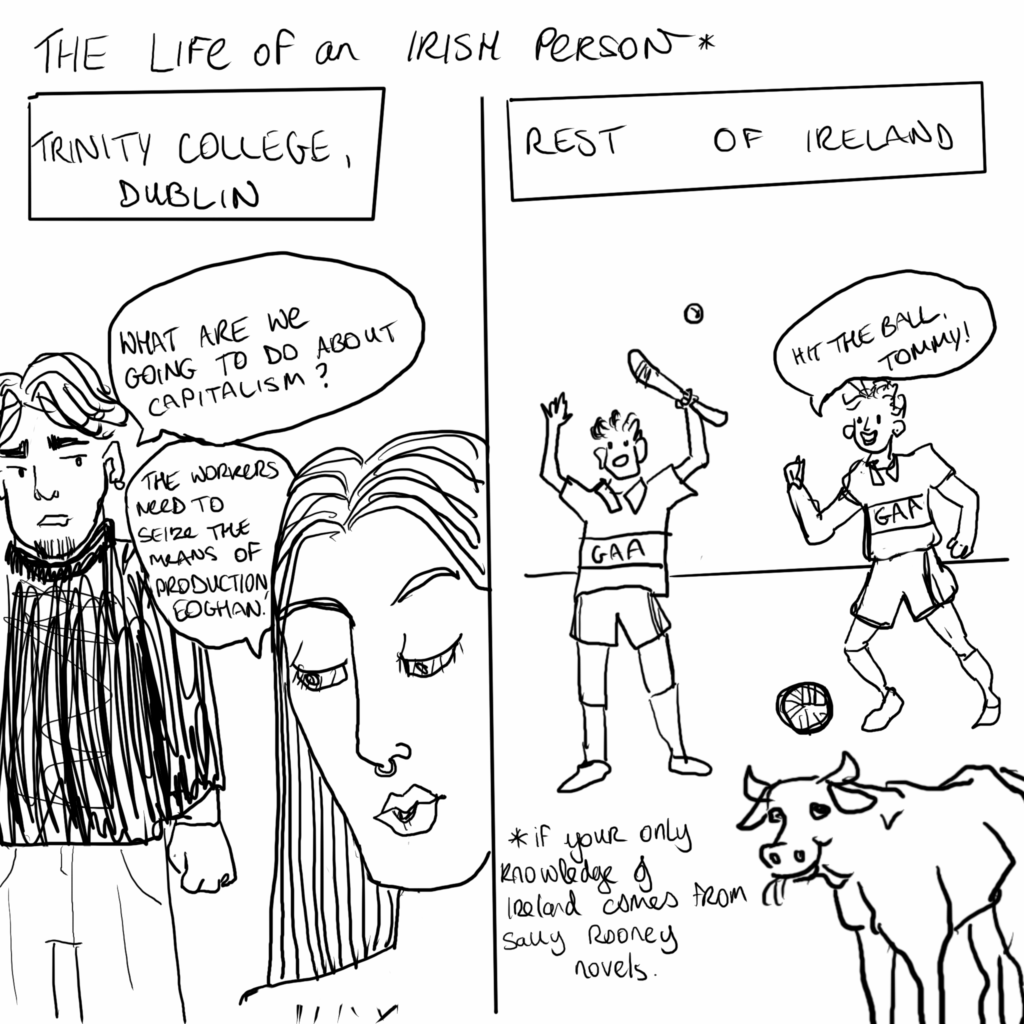
    A depiction of Trinity College on the left. A male student in a turtleneck asks “what are we going to do about capitalism?” A woman with long hair and a nose ring answers “the workers need to seize the means of production, Eighan.” In the rural scene, two men in GAA outfits play hurling and football. One says to the other “hit the ball, Tommy!” A cow smiles blithely in the foreground. The heading is “the life of an Irish person *” at the bottom is written “*if your only knowledge of Ireland comes from Sally Rooney books”
    This may not be entirely fair, but I did have fun making it.

    I’m not sure to what extent Rooney is gently ribbing her characters when they go on pretentious political screeds in the middle of a café or house party. I suspect she is poking a bit of fun at how students do go on like this, but she does also put some actually insightful political stuff in there as well. I don’t think my satire quite works as the main character here would probably be in the middle of the refugee/human rights discussion rather than scorning it, but I did just want to make fun of that tendency in her novels.

    Also, and this may be because I’m not nineteen, but the youth of the characters sometimes didn’t ring true to me. True, I didn’t study at Trinity, so maybe I didn’t witness this level of pretention. The only Trinity nerds (I use this term with affection) I knew were studying music, and they used to entertain themselves by humming a note in unison after banging a tuning fork they’d whipped out of seemingly nowhere. Is that the music equivalent of what Rooney’s students do? Actually, it might be.

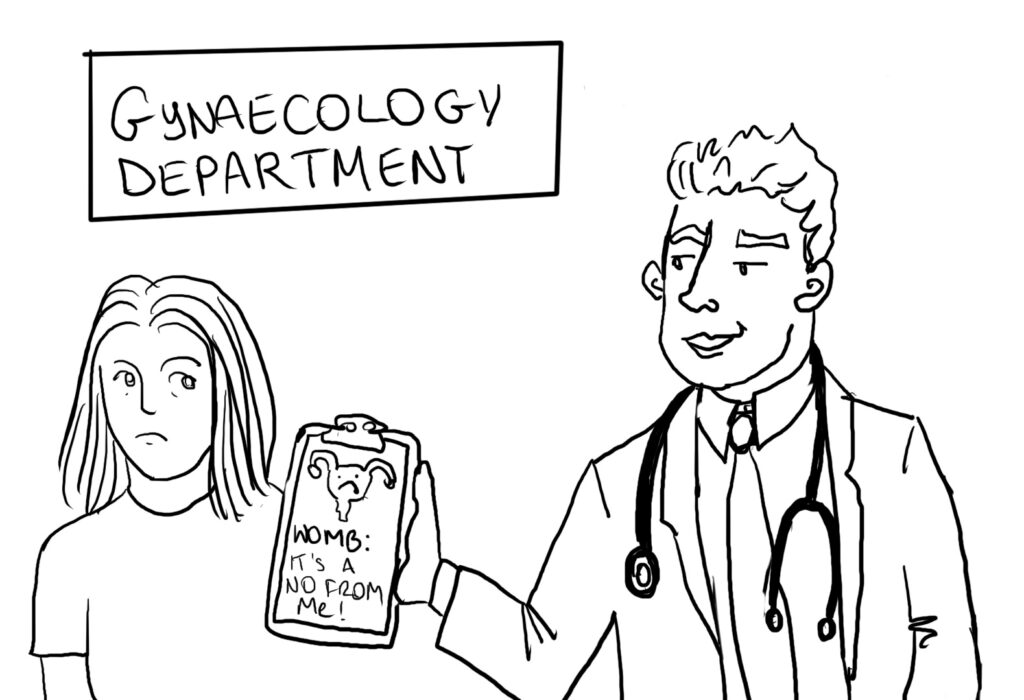
    A young woman looks nervously at a cocky looking doctor who is waving a chat that has a drawing of the female reproductive system, followed by the words “womb: it’s a no from me”
    Fun with healthcare

    I really enjoyed writing a doctor saying this and imagining how these novels would be if people said things like “tough luck” and “no bueno”. He’s kind of a ’90s dude from American Pie or something.

    Sometimes the callousness of Frances’ medical interventions felt overblown, but when I remember my own experiences with period pain in my teenage years, I think Rooney’s representation of this is fair. I used to writhe in pain, feeling as if my internal organs were being ground up like in Sweeney Todd, being actually certain that something must be horribly wrong. Pain is supposed to be a sign that you are taking damage (OK gamer), but when I spoke to GPs about this, there was no interest in scheduling a scan, or checking out my organs. They simply diagnosed me with dysmenorrhea. This is a disorder which means you have bad period pain.

    At the time, it felt like I went to a doctor with a hole in my head only to be diagnosed with hole-in-the-head-itis and charged €60 for the pleasure. Thank god for the pill, which calmed it all down (though of course now I have to deal with the fearmongering about if the Pill is secretly destroying me too). I remember having an ultrasound in my mid-twenties for something else, and being so relieved to finally get confirmation that I actually had a reproductive system in there, since my agonising teenage periods had made me feel as though it must have been converted into some kind of chamber of horrors.

    I think Rooney solidly represents how painful and farcical it can be trying to have your ob/gyn needs taken seriously.

    One of the reasons I wanted to write this is because I will delete my X account soon. I hate the idea that funny stuff like this is still hanging in suspended animation while 20% actual weirdos and 80% bots say the most heinous shit imaginable to one another, all while Elon “le epic win, you win the Internet today sir, have my updoot” Musk feeds it all indiscriminately to his pointless AI “Mechahitler”.

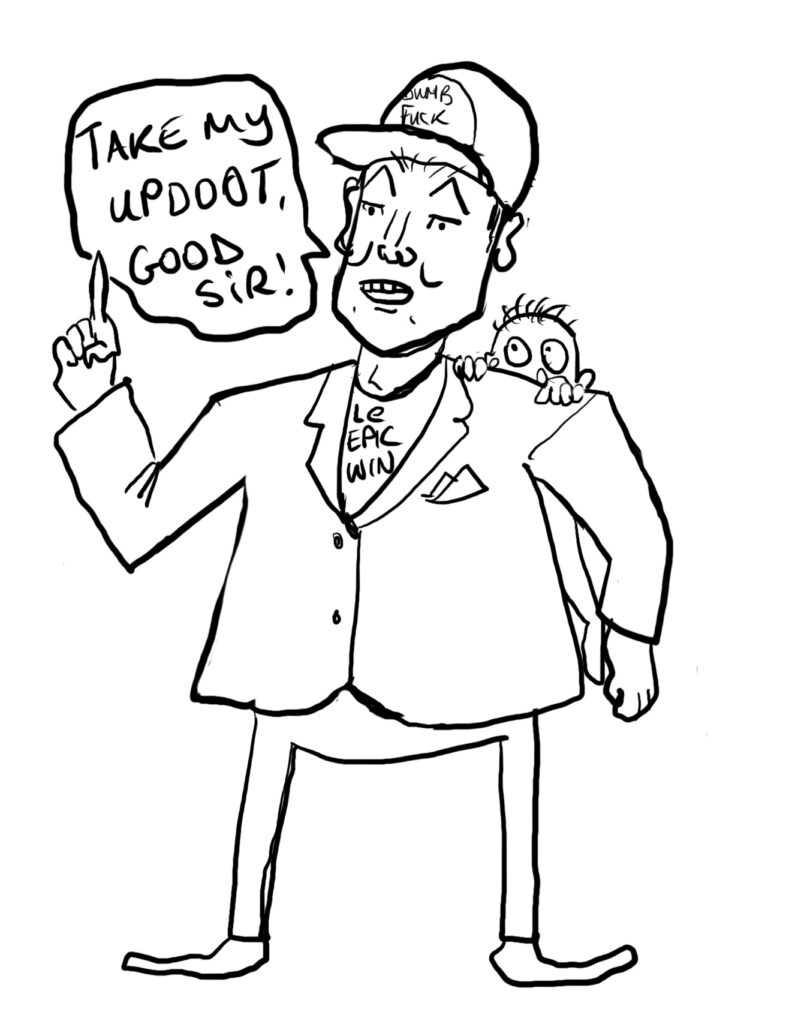
    A drawing of a man resembling Elon Musk, wearing a hat saying "dumb fuck" and a t-shirt under a blazer saying "le epic win". He holds his finger up as if making a point, and a speech bubble says "Take my updoot, good sir!". An infant dangles from his left shoulder.
    He looks like he should be named Grok.

    I want to delete my X account, but I’m embarrassingly very proud of this thread and the Twitter fame that it afforded me. I remember in the weeks following, my friend sent me a tweet that almost word-for-word copied my opening tweet,. I posted a reply: “Very funny – it was also funny when I first said it on 24 July”. The person deleted their plagiarism. But it hit me that my most famous piece of writing is in a very precarious position on the Internet, and it is not attached to my name.

    Do I want it attached to my name?

    In one cowardly sense, no. I am infinitely more comfortable with the idea that strangers on Twitter hear me talking about vaginal orgasm than people in my real life. Of course, my parents have read the thread, as have my family and friends, and thankfully we all ignore the parts that are on a TMI level.

    In another sense, I am very proud of this, even though it was not actually that huge a thing. Currently, post-mass-Xodus from the platform, its first tweet has 15.45K likes, 1.27K RTs and 93 comments. It has 1 million impressions, 197K engagements and 162K detail expands. I don’t really know how big that is in the grand scheme of things, but I was never asked to sell vibrators in the comments below as other viral Twitter users were, so it can’t have been that impactful. But to this day, people like it. Since yesterday, two people have liked the first tweet. In all likelihood, they are OF bots or future mass killers, as is the main userbase of X, but that’s something.

    In the days following the viral moment, I removed Twitter from my shortcuts because it made it feel like my heart had crawled up into my throat when I would see the piles of notifications. There was a small bit of not-quite-backlash, of people thinking it was begrudgery and negativity to criticise Rooney’s work. I could never deny a level of begrudgery, as I am Irish. Luckily, I think the silliness of the parody kept the majority of people from thinking I was being totally horrible.

    I will also say that Rooney deserves the praise and success that she has received. Even though some parts compelled my eyes to roll, I kept turning those pages addictively. I also felt like Conversations with Friends had a real skill in not lingering too long on any particular scene. It trips along nicely, and you get a real sense of place. I also love the first part of Normal People where Connell and Marianne are teenagers, which mirrored a similar situation that had happened to someone close to me. I think Rooney’s way of showing how Connell hurt Marianne, not through malice but through fear and social expectations of masculinity, was really impactful.

    Fundamentally, a good writer is someone who keeps you reading, and Sally Rooney does that with apparent ease. Whatever problems I might have with her writing, she is not overrated and is very deserving of her success.

    Well, would you call a wonderful marriage and four beautiful children a success?

    I’m joking, we didn’t procreate, marry, or hang out again, but the date was nice.

    It lashed rain but we stayed under an umbrella in the park, sipping cans until our bladders demanded shelter. We went to his place, it was nice enough, and I apologetically had to keep checking my phone in disbelief as the thread continued to blow up.

    Neither of us felt a great connection to the other, but it was a very nice date, especially as it was the first time since the pandemic that I’d met someone new.

    The purpose of this blog post is to save my tweets somewhere that is not X. The point is to have some evidence of having owned this viral moment. It’s a bit self-indulgent but maybe I need to lean into my inner Rooney heroine. At least they (and Rooney) actually have the discipline to get things written and published.

    The purpose of this blog generally is to write. I have missed getting my words out there like I used to with Twitter. Unlike Twitter, this blog will force me to develop said words to something more than a pithy blurting of a thought.

    I’m going to write about media, mostly, and how I feel about it. I keep having ideas for podcasts, then not doing anything with them. I suspect a blog will suffice for now.

    Goodbye, Twitter, you were great and awful. 

    Subscribe

    Intuit Mailchimp