Category: Television

  • Pick-Mes and Girl’s Girls

    On a baby-blue background, pink serif lettering reads "Pick-mes and Girl's girls". There are white-and-yellow daisies on some of the letters.
    Let’s have an internalised misogyny. I wanna have an internalised misogyny. Lock the doors TIGHT: let’s have an internalised misogyny.

    I’m not on TikTok, but I keep somewhat up to date on what’s happening over there through YouTube. I tend to get the slightly more digested content, though. By the time the story about the girl who thinks her therapist is in love with her has reached me, all the takes have been delivered and I get to watch a nice video essay about it.

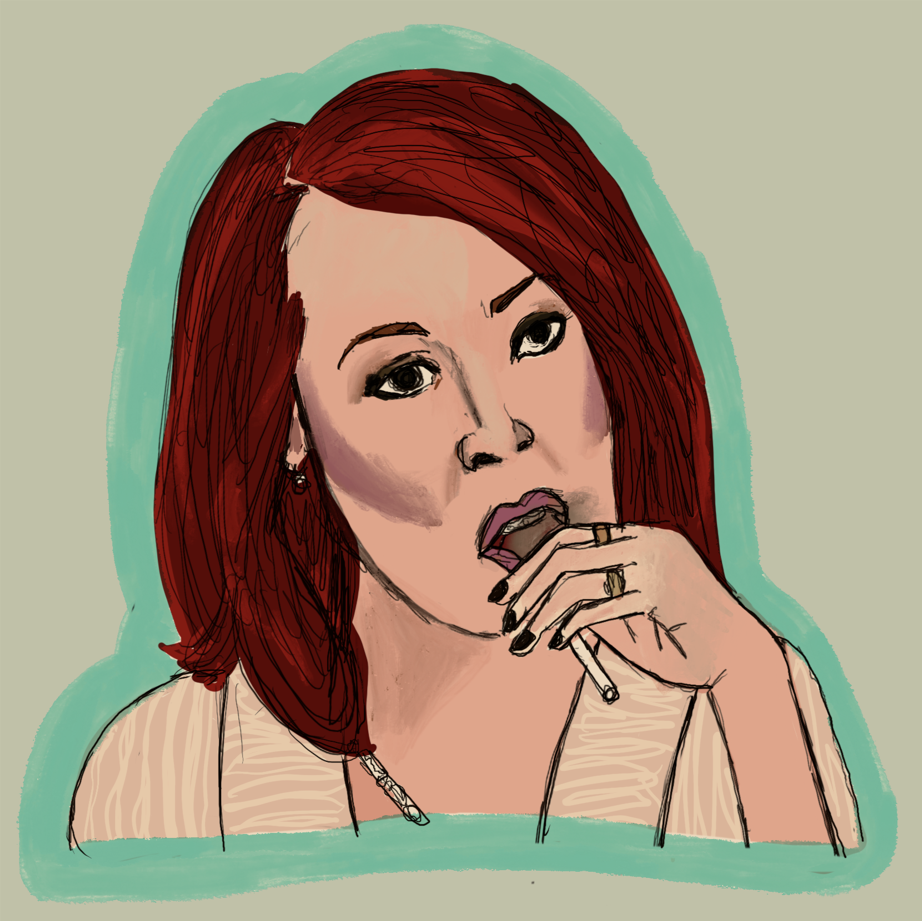
    Sometimes, though, a trend escapes TikTok itself. I knew this had definitively happened when I was watching the excellent Bravo show Ladies of London. A woman in her forties or fifties accused one of her fellow castmates of not being a girl’s girl. This woman, Kimi, whose father was one of Papa Doc Duvalier’s staffers (not relevant but just a wild fact), comes across as a “Oh, none of this silly American malarkey for me” type, and yet she rattles off the “not a girl’s girl” criticism, without a shred of awareness of how TikTokified that is of her to do. To me, that was a sign that the term had truly escaped the internet and entered the mainstream.

    I had already been looking askance at this term, and the proliferation of pick-me criticism, because of great Youtubers like Mooknee and Jordan Theresa. There’s a great one about the entire girlhood discourse by Shanspeare which touched on this too. I had seen it crop up in other Bravo shows like the new Vanderpump Rules reboot, but that was hardly surprising since they’re all Gen Z, based in LA and at least half of them are professional content creators.

    But first, let’s get into these two terms, the pick-me and the girl’s girl, what they mean and how they are utilized.

    Pick-Mes

    A pick-me is a girl/woman who appears to tailor herself to men. The pick-me wants to be picked, chosen. In Gillian Flynn’s novel Gone Girl and its adaptation by David Fincher, the “cool girl” monologue seemed to kick off this pick-me backlash in the zeitgeist.

    I really recommend reading the whole piece (or the whole novel, honestly) because it is impeccable. It describes how women are tempted to become this version of themselves that is engineered around being attractive, unchallenging, available and flattering to the man they are with or who they want to be with, or even just men in general.

    Flynn also describes how it isn’t just the ‘normie’ girls that are the Cool Girl – every subculture has them. I think back to college, sitting on a couch in the Hub café in NUIG, eavesdropping on a gang of anime nerds, with the one girl in the group joining in on the sexist jokes to maintain that golden feeling of being the Cool Girl. I remember going to my then-boyfriend’s house, sitting beside him for hours while he played video games and barely spoke to me. I’d laugh along at all the things that he and his friends might say, whether I agreed with them or not, feeling the glow of acceptance from these men.

    Is there some primordial feeling of safety that comes with being accepted by men? Is there perhaps a sense in my lizard survival brain that I am more likely to live longer if I suck up to the guys who are in charge? Even if the guys in question have more interest in Magic: The Gathering than in any kind of conquest (thank god, and to their credit)?

    Either way, this is pick-meism. Let us be honest and confess that most of us women have been a pick-me at some point or another.

    Accusations of pick-me behaviour used to be levelled towards women who derided feminism because “I love men”, or women who said “I’ve always just gotten on better with men, there’s too much drama with girls”. How infuriating, and what a helpful term to take the self-righteous wind out of their sails. It’s an important milestone in fourth wave feminism, I think, the definition of the Cool Girl.

    However, the internet, through the initial incisive takes on Twitter and Tumblr, which then become deep-fried screenshots on Instagram, distilled the “pick-me” concept, until soon the general public start throwing the term around. Then, the Bravo-lebrities beging using the term. Finally, men start calling women pick-mes, and the original purpose of the word has sadly been inverted to be yet another way for men to critique how women present themselves to them.
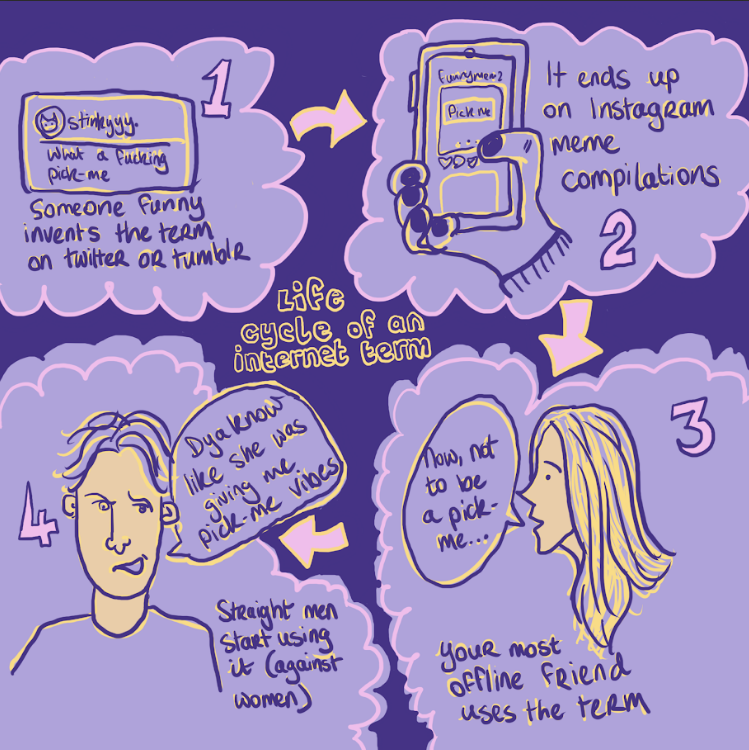
    A doodle in purple, yellow and pale pink showing the life cycle of an internet term. Step 1, named "Someone funny invents the term on Twitter or Tumblr" shows a tweet-like post thar reads "what a fucking pick-me". Step 2 is "It ends up on meme compilations" and shows the aforementioned post as part of a meme dump on Instragram. Stage 3 is "Your most offline friend uses the term" and shows a woman with blonde hair saying "Now, not to be a pick-me". Stage Four is "Straight Men Start Using the Term (Against Women)" and shows a wry-looking man saying "Do ya know, like, she was giving me pick-me vibes”
    The lifecycle of an internet term.

    On the new season of rebooted Vanderpump Rules, Angelica accuses Audrey of being a pick-me for not being sufficiently grossed out by her boyfriend’s penis pump and OnlyFans work. A few episodes later, Audrey accuses Angelica of being a pick-me. She doesn’t cite any reasons in particular, but Angelica does come across as being very focused on male attention in a number of ways. However, this is where the issue lies: a pick-me is something women accuse each other of being when they are in conflict, and it’s based on vibes rather than actual actions.

    One could argue that a pick-me now has to sufficiently feign complete and utter disinterest in a man’s opinion of them if they want to be picked. What quicker way to do that than to claim that all of your actions and motivations are actually in the service of your fellow women? Or wait, sorry, your fellow girls?  

    That you are, in fact, a girl’s girl?

    Girl’s Girls

    According to TikTok, here’s what a Girl’s Girl does:

    • Tells other women when they have toilet paper on their shoe
    • Tells other women when they have something on their face
    • In the improbable event that your mortal enemy is being cheated on, you tell your mortal enemy and team up to bring the bastard boyfriend to justice, just like when the X-Men would team up with Magneto or whoever
    • Agrees with other women

    Incidentally, I’ve noticed that girl’s girl behaviour exemplars are often confined to the social/dating spheres, and not as often to the working world.

    I see the concept of a Girl’s Girl as being like Taylor Swift’s definition of feminism that she deployed against Amy Poelher and Tina Fey after they (rather gently I thought) made fun of her at the Golden Globes in 2013: “There’s a special place in hell for women who don’t help other women.”

    To be fair to Taylor, I get the general point she’s making – that it’s sad when women target one another over things that aren’t that bad when there are literal rapists sitting nearby.

    However, the logic falls apart. It’s a condescending notion, that we as women should automatically support one another. Are my beliefs, interests and opinions superseded by my gender to the point that they are irrelevant? Does this not reduce the sphere of influence of women, and deepen the idea that women need to all play nicely together in one supportive sandbox and never let any naughty boys near us?

    The Youtubers I linked above did a great job of describing how this girlhood internet discourse straddles a fine line between empowerment and infantilisation (a line that also often comes up is discourse around sex and relationships for women – is she into BDSM because that’s she’s empowered or because she’s being controlled and infantilised by her male partners?). I believe that women can feel girlish and relate to girlhood to whatever extent is preferable to them. I take issue with this definition of girlhood being weaponised against other women who did not sign up to perform it.

    It’s interesting that we don’t bring it into the workplace as much, and probably a positive sign. Calling yourself a girlie-pop is a social tool, but most women are absolutely not into being treated like a girlie-pop in the workplace.

    Back to the girl’s girl method of being a good person to other women, I much prefer the idea that we try not to be cruel to anyone. Most nice women generally come across as “girl’s girls” because we will be better at supporting or protecting other women from cruelty or an embarrassing situation, because we can relate and generally feel safer intervening on behalf of a woman, because the outcome will be more predictable and feel safer.

    I’m not going to be deliberately obtuse here, though. What a lot of proponents of being a “girl’s girl” are referring to is the idea that a woman should make the brave choice to stand up against mistreatment of their fellow woman, even when it doesn’t benefit them.

    As an example, let’s say a man you are attracted to calls another woman some horrible word like “slut”. In that moment, you have the choice to ingratiate yourself further with this man by supporting his statement or by ignoring it, or you can stick up for the woman even though it will damage your relationship with the man. “Girl’s girl”-ism is the awareness that this decision is made far easier when you automatically prioritise other women.

    However, as I am seeing with my reality tv consumption and the internet drama that I come across, accusations that a woman is “not a girl’s girl” has, conversely, become a really popular way for women to attack each other, in the name of sisterhood. “Support all women!” has added the suffix “and exclusively criticise women for falling short of expectations!”, becoming a womanhood ouroboros, eating itself. Women fight one another for not supporting women enough.

    It’s genius, really. You can shit alllll over a woman that annoys you, and you aren’t even doing any internalised misogyny because that woman is a pick me, and you? You are a girl’s girl. In fact, you are policing against internalised misogyny. You are like the Judge Dredd of Girlhood.

    A drawing of Judge Dredd, from 2000AD comics. Instead of his normal red stripe on the helmet, he has a pink one. His green gloves, elbow pads and belt are a cuter, more pastel shade of green.
    I AM the Girl-Law!

    It has gotten to the stage that people will say, as if this counts as evidence of malfeasance, that someone gives VIBES of being a pick me, or not a girl’s girl. We can justify our treatment of one another by imagining how our target feels about other women. And yes, we will call everyone “girls”.

    The new lens of the Panopticon

    To avoid pick-me allegations, do we now have to cultivate, or at least pretend to have, absolute indifference to men and to their treatment of us?

    Does this not let men off the hook? If the only people from whom we expect respectful treatment are other women, then do we not absolve men of any responsibility for how they treat people?

    It can be cathartic to say, in a world-weary tone, “Men are trash”. But when you internalise that, you hold only women to any standard. Men can cheat, and use people, but you know who’s really disgusting? The girl who he cheated with, because she’s not a girl’s girl. Because she should know better. And she should automatically have an inherent respect for me and for all women which should cause her to be flawless in her treatment of other women forever.

    Here’s another thing to bear in mind about pick-mes. The girl who claims that she just gets on better with men, or that women are bitches: she’s hurt. And maybe she has been hurt by women in ways that men have never hurt her. Maybe she finds the politics in male friend groups are less thorny than those she may have experienced with her fellow girls in primary or secondary school.

    You can scream at her all you want about the sisterhood, but that isn’t going to heal her trauma and have her running to be your friend(not that you were offering!). In short: yes, the pick-me is steeped in internalised misogyny, but give her a fucking break.

    Most of the pick-mes who I have met were people who had been bruised by societal expectations around femininity. How they have responded to that, theoretically and societally, might be problematic, but you have to allow individuals to cope with their life experiences in the best way that they know how.

    But the idea that we are infantilising ourselves is worrying. Why are we showing off our tiny girl dinners and our girl math that allows us to pursue all our girlie widdle interests, like buying bags and frappuccinos?

    In short, I think women are tired. After all the candour and anger of MeToo, we’ve found ourselves in this shitshow. Politicians, not just in the absolute haunted hayride that is the United States, are advocating for women to leave the workforce. Men make fortunes out of ranting about how women should be financially dependent on their partners while simultaneously condemning them as parasites. I think a lot of men saw that, in the wake of MeToo, they could form social bonds by not being sorry for how women have been exploited, social bonds with the true targets of their attention: other men.

    And so, on the Internet we see men performing for men in the manosphere and women performing for women in the girliesphere. Women aren’t even going to begin criticising men because we’ve seen how little that works, so our frustration is channeled at one another, in our little playground. Every so often, a man notices what we’re up to and learns some new ways to kick dirt at us.

    Pick-me and girls’ girl discourse makes me think of the Panopticon, the conceptual prison in which the inmate lives in the knowlede that at any moment, they could be surveilled.

    Side note: I studied English at university, and I feel like the Panopticon came up way more often than one would reasonably expect. Lecture One: Learning Outcomes, Key Texts. Lecture Two: The Pantopticon. Course title? Could be anything from Modernism to Medieval Poetry. I think the English department had some kind of bet going.
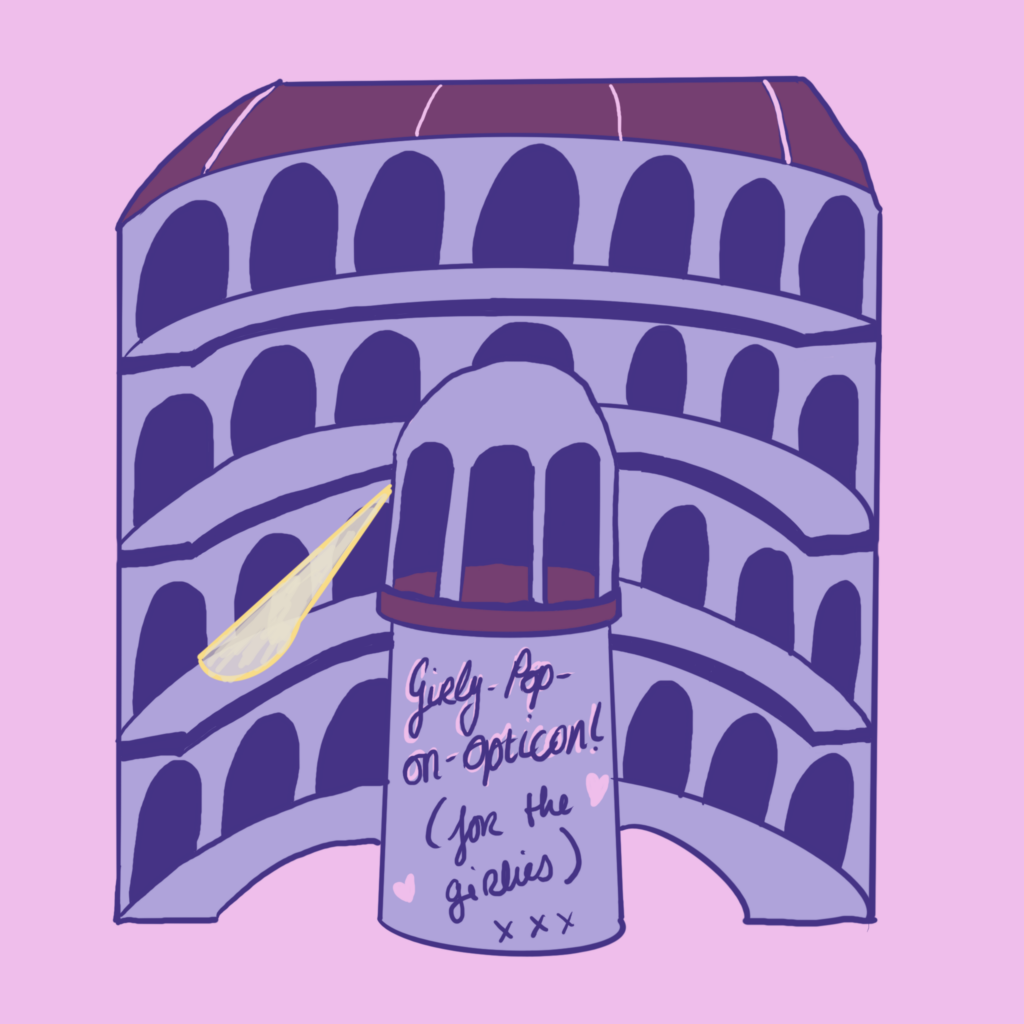
    A drawing of the Penopticon, in which a central tower can view an interior cylinder of cells which all face the central tower. On the tower, it says "Girly-pop-on-opticon! (For the girlies) xxx" with two pink hearts as well.
    A what? A girly-pop-on-opticon!

    In this Panopticon, gender is performed for the Internet gaze, and women (girls) must feign that they do not perform at all for the male gaze. Men can now join in on the fun, and ridicule the women they feel perform too much for their gaze, using the terms they hear women using to ridicule one another.

    Girls’ girls hoist their fellow women to the pyre, in the service of performing how little they care about male attention, crying accusations of “pick-me!” that sound an awful lot like “pick me”.
  • The Real Housewives of Wherever

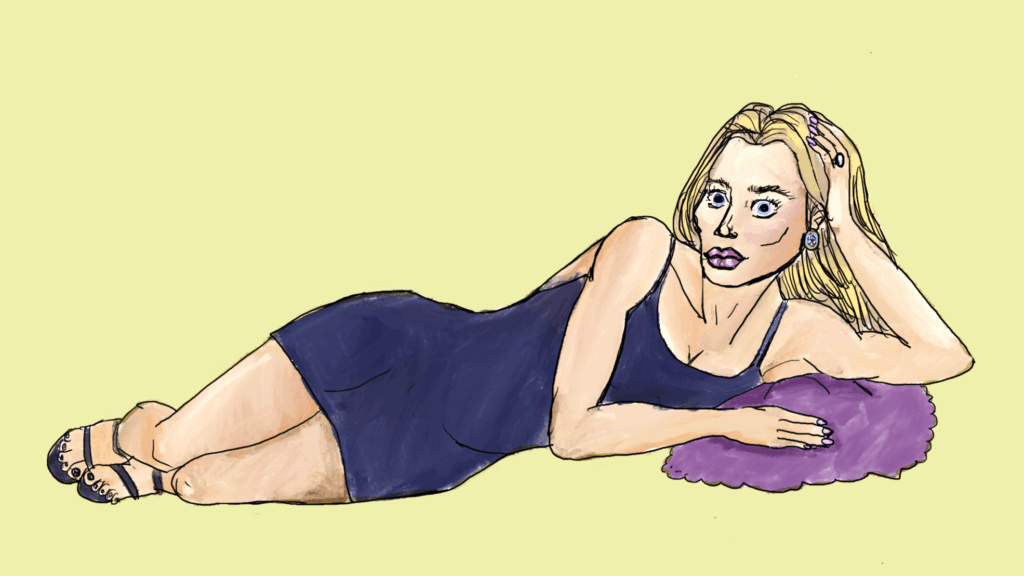
    A generic Real Housewives woman, with defined features suggestive of cosmetic procedures and a very toned, slender body, with blonde hair, blue eyes and tanned skin, lounges on a purple pillow, wearing a dark blue dress and heels, with a diamond wedding ring and diamond earrings,

    Why can’t I quit my women? My harridans, my blatant capitalists, women who would cannibalise me if a plastic surgeon promised them that it would buy then ten more years of a a youthful-ish appearance?

    Who are these women of which I speak? They are the Real (debatable) Housewives (sometimes) of [city]. They are a stable of women who have access to some form of high status in the area where they live (or where they rent for the duration of filming, see: Meredith Marks who resides permanently in New York but films as part of the Salt Lake City cast). They form the casts of multiple reality shows, all owned and produced by Bravo, which is run by executive Andy Cohen.

    People who don’t watch these shows don’t understand why they occupy so much of my mind. In the interest of informing you, as this is my blog, let me try to provide you with an introduction to the Real Housewives.

    There is a strange certainty to a Real Housewives show. Some common threads:

    • 15-20 episodes per season (if Season 1 of a franchise, normally 8-10 episodes to see if the series works)
    • 5-8 “housewives”
    • An intro where the women say taglines about themselves. For instance: “There’s nothing grey about MY gardens!” says Sonja Morgan, who lives in a crumbling townhouse and is growing increasingly eccentric, like the documentary Grey Gardens. “If you don’t like my shade, step out of my shadow!” says Kenya Moore, who regularly eviscerates her foes with words alone.
    • Several parties. These can be exceedingly random: a bra party (a slightly baffling RHO New York event), or cliché: a vow renewal (often swiftly followed by a divorce announcement). These can also be expected: birthday parties and book launches, or they can be blatantly shoehorned in: launches of launches of books (Heather, RHO Salt Lake City), and fashion shows (sometimes with no fashion, see Sherée, RHO Atlanta).
    • A plotline for each housewife. If things get interesting enough, this plotline gets overshadowed by the way the season develops and conflicts emerge. Like when Luann from RHONY was delirious with joy about her impending nuptials only to find that her wedding plotline became a “He’s cheating on you regularly in your favourite watering hole” plotline. If things do not get interesting enough, you may find yourself painstakingly brought along to every step of the housewife, say, designing and launching a line of statement necklaces or some such thing.
    • 1-3 “friends of” – these are friends of the housewives, who may have been tested as full housewives but who ended up on the cutting room floor, or someone who emerges throughout the season as being somewhat relevant to the storyline(s). They can later become housewives, or housewives can be demoted to “friends of”. A demotion often follows a season as described above, where a housewife has no emerging plotline beyond remodelling their kitchen or launching a skincare line. Sometimes a true star emerges, like Britani from RHO Salt Lake City, who cemented her place in Bravo history by interrupting every conversation that didn’t involve her asking why nobody cared about her.
    • Talking heads/confessionals, where the ladies, the “friends of” and sometimes the husbands, react to the scenes. Once, Lisa Rinna of Beverly Hills drank from her drink through a straw in an emphatic manner to signify a kind of “I’m not gonna say anything but the moment speaks for itself” kind of way, so now all of the wives do that all the time, and it’s annoying.
    • One or two cast trips, where the ‘wives, often accompanied by their “friends of”, travel somewhere. Hopefully, this is an international location but sometimes, as when Jen Shah was awaiting sentencing for defrauding the elderly in RHO Salt Lake City, they must settle on a domestic destination.
    • The season ends on a party, mostly, ideally where one or more housewives have a big fight and storm off, then the audience is treated to freeze frames of each ‘wife with a little bit of text to resolve their storyline.
    • A reunion, increasingly released in 3 parts, but in earlier franchises and seasons it would be one episode. In this reunion, the housewives all come to a Bravo soundstage where Andy Cohen (mostly – once it was Nicki Minaj, and some international franchises have a different host) holds their feet to the flames for their actions throughout the season. It is typically filmed when most of the season has aired, then it is released the week after the finale has aired. In the reunions, Andy reads definitely real texts from definitely real viewers reacting to the season. This can be very cathartic for the viewer. Sometimes (at least twice), a housewife will unveil a new music career in collaboration with their new surprise girlfriend. It’s not that weird, but it’s weird that it happened twice, with Kim Zolciak and Danielle Staub.

    On average, I watch about 4 episodes of Bravo shows per week, most often of the Real Housewives variety. I have a mental rolodex of women who wield power through their businesses, husbands or horrible tempers. Every so often, I zone out and flicker through them, wondering who would be better in real life, who would be worse and, weirdly, who would like me. Because, as much as the show revolves around “lifestyle porn” and excess, it is a lot more about social dynamics.

    The ‘wives think that they are signing on to do a show where they shock audiences with their diamond-encrusted toilet roll holders. Mostly, they think that the worst they will have to endure is our disgust at their material excess. They think that their castmates will make disgraces of themselves, but the housewife herself? Infallible. Rich, excessive, otherwise infallible.

    What we actually get from them is an oblivious performance of their foibles. For instance, a HW might think it perfectly reasonable to demand silence to tell a birthday party full of 7 year-olds, at great length, about the traumatic birth of her two daughters (Alexis, Real Housewives of Orange County). She might think it appropriate to bring protection in the form of Hell’s Angels and a recently released convict named Danny to a cancer benefit for a little baby, then proceed to threaten attendees because she was told she was in for “a surprise”, and to be outraged that her donation of zero dollars did not net her a table for her and her biker gang (Danielle, Real Housewives of New Jersey). She might think that filming a scene in her church where attendees break down in tears at the pulpit and call her their mother and an aspect of God will bust those nasty rumours that she is running a cult (Mary, Real Housewives of Salt Lake City). The through line here is that, to these individuals, they are coming across as normal and relatable.

    I have always wished to know what it is about me that would make viewers cringe in the way the above scenes made me cringe. If Real Housewives is to be believed, all people are walking around life thinking that they are being perfectly reasonable while acting absolutely batshit. Even the sane people in RH have moments where you remember “Oh yes – these are the type of people who would agree to be on this show.” No amount of apparent sensibility can outweigh that fact.

    As a generally anxious person, I would like to know what is my “bringing a Hell’s Angel to a child’s cancer benefit”. We all have our blind spots, and in our real housewives, we get to see these blind spots performed and platformed and underlined. There’s a strange comfort to that.

    We can tell ourselves that our blind spots are not bad, in the grand scheme of things. Maybe you interrupt people accidentally. Maybe you are always late. Maybe you phrase things inelegantly. But there is a comfort to knowing that, however annoying you suspect you are, you will never interrupt a Black Shabbat dinner to talk about how Jewish people have always seemed to conspire to make you, a white Christian woman, feel unwelcome (Ramona, Real Housewives of New York).

    The curse of being a real housewife is every season, you must reckon with that which you had no idea was an issue. There are different ways that housewives deal with the revelation of their blind spot.

    The Camille Grammer approach: Switch the bitch

    Season One of the Real Housewives of Beverley Hills was incredible. Camille, then-wife of Frasier’s Kelsey Grammer, was the villain of the season, clashing early on with Kyle Richards, a seemingly innocent and sensible LA native.

    Kyle often gets a favourable edit, as she is generally quite sane, and can competently deliver a quip or two. She is also very much in the Hollywood mix: her sister and fellow castmate Kim is a troubled former child star and their other sister, Kathy, is mother to Paris and Nicky Hilton. Above them hovers the constant spectre of their mother, the ominously-named Big Kathy.

    Back to Camille. The conflict between Camille and Kyle began when Kyle said, off-camera and according to Camille, that if Camille went to Hawaii without her husband Kelsey, nobody would be interested in that. Kyle vehemently denies this (the clip repeats for the rest of the season: “You’re such a fucking liar, Camille!”).

    As the season progresses and the feud deepens, Camille does a number of infuriating and entertaining things. She compares herself to Jesus, she demonstrates a wonderful vocabulary in calling Kyle “pernicious”, slightly lets down that vocabulary by also calling Kyle “Machiavellic”, and she flirts in a weird, arch way with her married friend Nick.

    She tops it all off with a deranged dinner party featuring Allison DuBois, the psychic who inspired the show Medium. Du Bois spends the dinner vaping and threatening not to assist Kyle if anyone she loves ever goes missing, and promising Kyle “Your husband will never emotionally fulfil you”.

    A drawing of medium Allison DuBois, a woman with dyed red hair, tilting her head and vaping.
    An attempt was made to emulate Allison DuBois’ famous vape suck

    Camille kicked off the brand new franchise known as RHOBH with great style. The downside is that she set up a long tradition of intangible, offscreen feuds founded on unprovable things which continue to hound the show to this day. Did Lisa Vanderpump tell people to tell people that Dorit abandoned a dog?  Eh, probably, but we’ll never get the satisfaction of a reveal onscreen.

    Side note: if you like insane feuds and rumours which always come to be fully revealed in all their horror, watch Vanderpump Rules, a spin-off of RHOBH following Lisa Vanderpump’s desperate oversexed restaurant employees.

    Back (again) to Camille. Her arc comes to a sad end, as it became clear to the audience and to her that Kelsey had no interest in their marriage. It’s later revealed that he was having an affair the entire season.

    If we were to summarise Camille’s blind spot, it’s a flair for the dramatics that goes beyond the realm of normalcy. If Kyle’s original sin were, in fact, true, Camille certainly overreacts to it. She slinks around sexily like a Disney villain for her friends, and she summons strange allies to eviscerate her foes. Part of what makes her so compelling is imagining how mortifying it would be to be Camille, watching her behaviour on S1.

    When Season Two rolled around, viewers were treated to a humbler Camille, almost penitent. The other women pitied her for her marriage breakdown and seemed to have chalked her insane S1 behaviour up to that. She became a fan favourite, no longer the centre of attention but held in affectionate regard by viewers and ‘wives alike. She got the best of both worlds – an iconic season of jaw-dropping reality tv moments and a gentle landing into being more of a fun occasional addition. In a sense, she villained so hard in S1 that she earned an eternal place in the hearts of RHOBH fans, and she ceased it so crisply for S2 that she managed to avoid the general viewership thinking she is a fundamentally bad person. She still has her moments, though.

    The Ramona Singer approach: Never stop never stopping

    Ramona – the Christian jewellery self-described “maven”, who says she looks like she’s the sister of her teenage daughter Avery, who starts her own brand of Pinot Grigio and brings it to every party she attends by the crateload, who pretends to get trauma flashbacks if she’s stuck on a girls’ weekend and finds out there’s a great party happening back in the city, who throws wine glasses at the faces of her frenemies, who has defecated multiple times on the floors of holiday rentals and expects the staff to clean it up, who speaks ill of a recently deceased man to his former partner because he was an addict. Ramona, who has basically always been a nightmare of a person.

    Ramona has claimed repeatedly, season after season, to be learning from her mistakes. She has claimed to be a different person now every time a new season begins. Every season, she continues to be this exact way. But why would she change?

    Ramona still has friends, she’s invited to events, she lives a life free from shame for the litany of horrors that she has released upon on the world. Her Bravo career finally ground to a halt after she allegedly called a producer the n-word, to the surprise of nobody. But still, she perseveres!

    She is not just incapable of change, she is uninterested in it. She doesn’t need it either, because she is a wealthy white woman who spends her spare time a Mar-a-Lago, trying to hit the jackpot by catching the eye of some vile slug of a man. When her friends have finished destroying the world and climate change has wiped humanity off the planet, she’ll still be there, pooing on the floor of a hotel room bathroom and looking for a staff member to clean it up. Unfortunately, there’s no such thing as staff in the post-apocalyptic wasteland.

    What would I do?

    OK, so let’s say I’m a real housewife. I’m me, but I’m very thin and have had some ill-advised filler. My husband is a billionaire and he spends most of his time working in another country. I have two children and perhaps too many pets.

    While filming my first season, I would think that I am perfectly reasonable and nice and normal. Upon watching the show, I see that my castmates and viewers find me to be:

    • Occasionally foul-mouthed or purveyor of “too much information”. I’ll curse a lot, I’ll overshare about bodily functions and things that I get up to with my billionaire husband. This will certainly alienate some of the housewives and some viewers, but equally some viewers will find my critics to be prudish and prissy, and will rally to my side.
    • Untidy – my home will be lavish but cluttered and messy. One of the women sits on my couch and frowns. Seconds later she pulls a Louboutin stiletto out from under a cushion, a quizzical expression on her face. Unfazed, I say “That’s where it went!” Cue a confessional from the housewife who sat on the shoe, advising me to hire a cleaner. I will not (unlike other housewives) have dog shit on the floor, but, having too many pets, there will be hair everywhere and always a cat or dog underfoot.
    • Two-faced – Housewife A tells me that she thinks Housewife B was rude at the luncheon. I agree, and list all the many times that I found Housewife B to be unconscionably rude. Later, Housewife B talks about how Housewife A is always singling her out and being judgmental of her. I let B cry on my shoulder, reassuring her that she is perfect and flawless. I will argue at the reunion that I sincerely am just easily talked into people’s point-of-view, but I will be shouted down and will have to admit, tearfully, that I am two-faced.

    Following my first season, I will attend therapy for my two-facedness. My tagline for my second season will be “I may have two faces, but I keep them cute”. When people bitch to me about others, I engage with it but I constantly, annoyingly, walk back my statements immediately and provide alternate points of view. I find myself saying “but then again” a lot.

    I start selling a line of storage solutions for homes, having become (at least publicly) incredibly tidy. They’re called MessyGirl boxes. I also unveil a miniature version of my home where my pets live, named Chateau Animal.

    I continue my foul-mouthed ways but I have not forgotten the judgment of my castmates. Pretending to be light-hearted, I never mention it, but viewers can see through my façade to the seething rage below.

    It all unleashes itself on a booze-soaked trip to the Bahamas. Following my humiliating breakdown in the Bahamas, I become sober but I’m super condescending about it, especially at the reunion. In the interim between my second and third season, I am arrested in the Hamptons, drunk as a skunk, for public indecency and vandalism.

    Clearly this isn’t the first time I’ve thought about this.

    I hope that this post served as a kind of intro to a pop culture language that I am proud to be able to speak. When I meet someone new and find they also watch the Real Housewives, you instantly have hours of conversational inspiration. The Real Housewives franchises are probably bad things, overall, for and about the world, but they are cultural artefacts and deserve a place in the annals of television history.