I’m not on TikTok, but I keep somewhat up to date on what’s happening over there through YouTube. I tend to get the slightly more digested content, though. By the time the story about the girl who thinks her therapist is in love with her has reached me, all the takes have been delivered and I get to watch a nice video essay about it.
Sometimes, though, a trend escapes TikTok itself. I knew this had definitively happened when I was watching the excellent Bravo show Ladies of London. A woman in her forties or fifties accused one of her fellow castmates of not being a girl’s girl. This woman, Kimi, whose father was one of Papa Doc Duvalier’s staffers (not relevant but just a wild fact), comes across as a “Oh, none of this silly American malarkey for me” type, and yet she rattles off the “not a girl’s girl” criticism, without a shred of awareness of how TikTokified that is of her to do. To me, that was a sign that the term had truly escaped the internet and entered the mainstream.
I had already been looking askance at this term, and the proliferation of pick-me criticism, because of great Youtubers like Mooknee and Jordan Theresa. There’s a great one about the entire girlhood discourse by Shanspeare which touched on this too. I had seen it crop up in other Bravo shows like the new Vanderpump Rules reboot, but that was hardly surprising since they’re all Gen Z, based in LA and at least half of them are professional content creators.
But first, let’s get into these two terms, the pick-me and the girl’s girl, what they mean and how they are utilized.
Pick-Mes
A pick-me is a girl/woman who appears to tailor herself to men. The pick-me wants to be picked, chosen. In Gillian Flynn’s novel Gone Girl and its adaptation by David Fincher, the “cool girl” monologue seemed to kick off this pick-me backlash in the zeitgeist.
Men always say that as the defining compliment, don’t they? She’s a cool girl. Being the Cool Girl means I am a hot, brilliant, funny woman who adores football, poker, dirty jokes, and burping, who plays video games, drinks cheap beer, loves threesomes and anal sex, and jams hot dogs and hamburgers into her mouth like she’s hosting the world’s biggest culinary gang bang while somehow maintaining a size 2, because Cool Girls are above all hot. Hot and understanding. Cool Girls never get angry; they only smile in a chagrined, loving manner and let their men do whatever they want. Go ahead, shit on me, I don’t mind, I’m the Cool Girl.
Gone Girl, Gillian Flynn, 2012.
I really recommend reading the whole piece (or the whole novel, honestly) because it is impeccable. It describes how women are tempted to become this version of themselves that is engineered around being attractive, unchallenging, available and flattering to the man they are with or who they want to be with, or even just men in general.
Flynn also describes how it isn’t just the ‘normie’ girls that are the Cool Girl – every subculture has them. I think back to college, sitting on a couch in the Hub café in NUIG, eavesdropping on a gang of anime nerds, with the one girl in the group joining in on the sexist jokes to maintain that golden feeling of being the Cool Girl. I remember going to my then-boyfriend’s house, sitting beside him for hours while he played video games and barely spoke to me. I’d laugh along at all the things that he and his friends might say, whether I agreed with them or not, feeling the glow of acceptance from these men.
Is there some primordial feeling of safety that comes with being accepted by men? Is there perhaps a sense in my lizard survival brain that I am more likely to live longer if I suck up to the guys who are in charge? Even if the guys in question have more interest in Magic: The Gathering than in any kind of conquest (thank god, and to their credit)?
Either way, this is pick-meism. Let us be honest and confess that most of us women have been a pick-me at some point or another.
Accusations of pick-me behaviour used to be levelled towards women who derided feminism because “I love men”, or women who said “I’ve always just gotten on better with men, there’s too much drama with girls”. How infuriating, and what a helpful term to take the self-righteous wind out of their sails. It’s an important milestone in fourth wave feminism, I think, the definition of the Cool Girl.
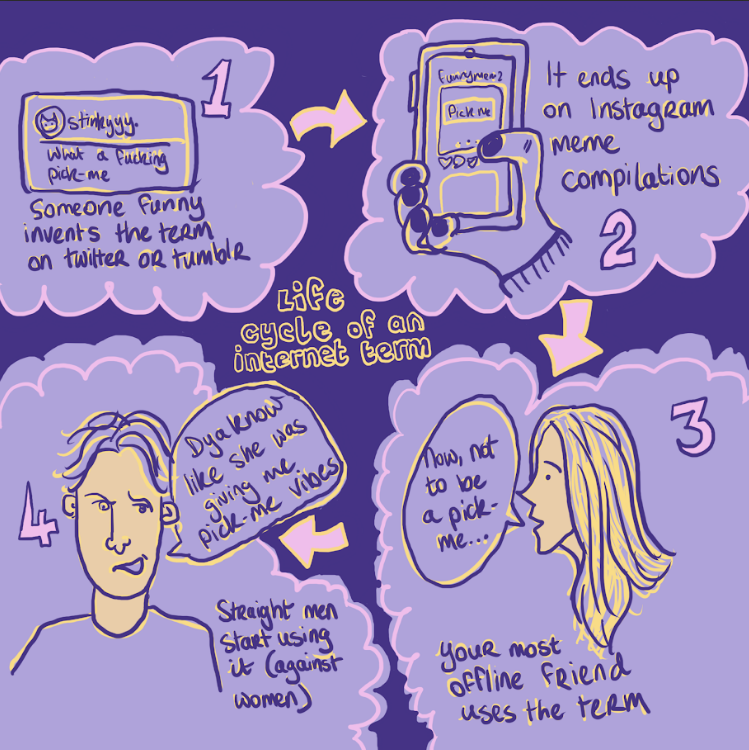
However, the internet, through the initial incisive takes on Twitter and Tumblr, which then become deep-fried screenshots on Instagram, distilled the “pick-me” concept, until soon the general public start throwing the term around. Then, the Bravo-lebrities beging using the term. Finally, men start calling women pick-mes, and the original purpose of the word has sadly been inverted to be yet another way for men to critique how women present themselves to them.
On the new season of rebooted Vanderpump Rules, Angelica accuses Audrey of being a pick-me for not being sufficiently grossed out by her boyfriend’s penis pump and OnlyFans work. A few episodes later, Audrey accuses Angelica of being a pick-me. She doesn’t cite any reasons in particular, but Angelica does come across as being very focused on male attention in a number of ways. However, this is where the issue lies: a pick-me is something women accuse each other of being when they are in conflict, and it’s based on vibes rather than actual actions.
One could argue that a pick-me now has to sufficiently feign complete and utter disinterest in a man’s opinion of them if they want to be picked. What quicker way to do that than to claim that all of your actions and motivations are actually in the service of your fellow women? Or wait, sorry, your fellow girls?
That you are, in fact, a girl’s girl?
Girl’s Girls
According to TikTok, here’s what a Girl’s Girl does:
- Tells other women when they have toilet paper on their shoe
- Tells other women when they have something on their face
- In the improbable event that your mortal enemy is being cheated on, you tell your mortal enemy and team up to bring the bastard boyfriend to justice, just like when the X-Men would team up with Magneto or whoever
- Agrees with other women
Incidentally, I’ve noticed that girl’s girl behaviour exemplars are often confined to the social/dating spheres, and not as often to the working world.
I see the concept of a Girl’s Girl as being like Taylor Swift’s definition of feminism that she deployed against Amy Poelher and Tina Fey after they (rather gently I thought) made fun of her at the Golden Globes in 2013: “There’s a special place in hell for women who don’t help other women.”
To be fair to Taylor, I get the general point she’s making – that it’s sad when women target one another over things that aren’t that bad when there are literal rapists sitting nearby.
However, the logic falls apart. It’s a condescending notion, that we as women should automatically support one another. Are my beliefs, interests and opinions superseded by my gender to the point that they are irrelevant? Does this not reduce the sphere of influence of women, and deepen the idea that women need to all play nicely together in one supportive sandbox and never let any naughty boys near us?
The Youtubers I linked above did a great job of describing how this girlhood internet discourse straddles a fine line between empowerment and infantilisation (a line that also often comes up is discourse around sex and relationships for women – is she into BDSM because that’s she’s empowered or because she’s being controlled and infantilised by her male partners?). I believe that women can feel girlish and relate to girlhood to whatever extent is preferable to them. I take issue with this definition of girlhood being weaponised against other women who did not sign up to perform it.
It’s interesting that we don’t bring it into the workplace as much, and probably a positive sign. Calling yourself a girlie-pop is a social tool, but most women are absolutely not into being treated like a girlie-pop in the workplace.
Back to the girl’s girl method of being a good person to other women, I much prefer the idea that we try not to be cruel to anyone. Most nice women generally come across as “girl’s girls” because we will be better at supporting or protecting other women from cruelty or an embarrassing situation, because we can relate and generally feel safer intervening on behalf of a woman, because the outcome will be more predictable and feel safer.
I’m not going to be deliberately obtuse here, though. What a lot of proponents of being a “girl’s girl” are referring to is the idea that a woman should make the brave choice to stand up against mistreatment of their fellow woman, even when it doesn’t benefit them.
As an example, let’s say a man you are attracted to calls another woman some horrible word like “slut”. In that moment, you have the choice to ingratiate yourself further with this man by supporting his statement or by ignoring it, or you can stick up for the woman even though it will damage your relationship with the man. “Girl’s girl”-ism is the awareness that this decision is made far easier when you automatically prioritise other women.
However, as I am seeing with my reality tv consumption and the internet drama that I come across, accusations that a woman is “not a girl’s girl” has, conversely, become a really popular way for women to attack each other, in the name of sisterhood. “Support all women!” has added the suffix “and exclusively criticise women for falling short of expectations!”, becoming a womanhood ouroboros, eating itself. Women fight one another for not supporting women enough.
It’s genius, really. You can shit alllll over a woman that annoys you, and you aren’t even doing any internalised misogyny because that woman is a pick me, and you? You are a girl’s girl. In fact, you are policing against internalised misogyny. You are like the Judge Dredd of Girlhood.

It has gotten to the stage that people will say, as if this counts as evidence of malfeasance, that someone gives VIBES of being a pick me, or not a girl’s girl. We can justify our treatment of one another by imagining how our target feels about other women. And yes, we will call everyone “girls”.
The new lens of the Panopticon
To avoid pick-me allegations, do we now have to cultivate, or at least pretend to have, absolute indifference to men and to their treatment of us?
Does this not let men off the hook? If the only people from whom we expect respectful treatment are other women, then do we not absolve men of any responsibility for how they treat people?
It can be cathartic to say, in a world-weary tone, “Men are trash”. But when you internalise that, you hold only women to any standard. Men can cheat, and use people, but you know who’s really disgusting? The girl who he cheated with, because she’s not a girl’s girl. Because she should know better. And she should automatically have an inherent respect for me and for all women which should cause her to be flawless in her treatment of other women forever.
Here’s another thing to bear in mind about pick-mes. The girl who claims that she just gets on better with men, or that women are bitches: she’s hurt. And maybe she has been hurt by women in ways that men have never hurt her. Maybe she finds the politics in male friend groups are less thorny than those she may have experienced with her fellow girls in primary or secondary school.
You can scream at her all you want about the sisterhood, but that isn’t going to heal her trauma and have her running to be your friend(not that you were offering!). In short: yes, the pick-me is steeped in internalised misogyny, but give her a fucking break.
Most of the pick-mes who I have met were people who had been bruised by societal expectations around femininity. How they have responded to that, theoretically and societally, might be problematic, but you have to allow individuals to cope with their life experiences in the best way that they know how.
But the idea that we are infantilising ourselves is worrying. Why are we showing off our tiny girl dinners and our girl math that allows us to pursue all our girlie widdle interests, like buying bags and frappuccinos?
In short, I think women are tired. After all the candour and anger of MeToo, we’ve found ourselves in this shitshow. Politicians, not just in the absolute haunted hayride that is the United States, are advocating for women to leave the workforce. Men make fortunes out of ranting about how women should be financially dependent on their partners while simultaneously condemning them as parasites. I think a lot of men saw that, in the wake of MeToo, they could form social bonds by not being sorry for how women have been exploited, social bonds with the true targets of their attention: other men.
And so, on the Internet we see men performing for men in the manosphere and women performing for women in the girliesphere. Women aren’t even going to begin criticising men because we’ve seen how little that works, so our frustration is channeled at one another, in our little playground. Every so often, a man notices what we’re up to and learns some new ways to kick dirt at us.
Pick-me and girls’ girl discourse makes me think of the Panopticon, the conceptual prison in which the inmate lives in the knowlede that at any moment, they could be surveilled.
Side note: I studied English at university, and I feel like the Panopticon came up way more often than one would reasonably expect. Lecture One: Learning Outcomes, Key Texts. Lecture Two: The Pantopticon. Course title? Could be anything from Modernism to Medieval Poetry. I think the English department had some kind of bet going.
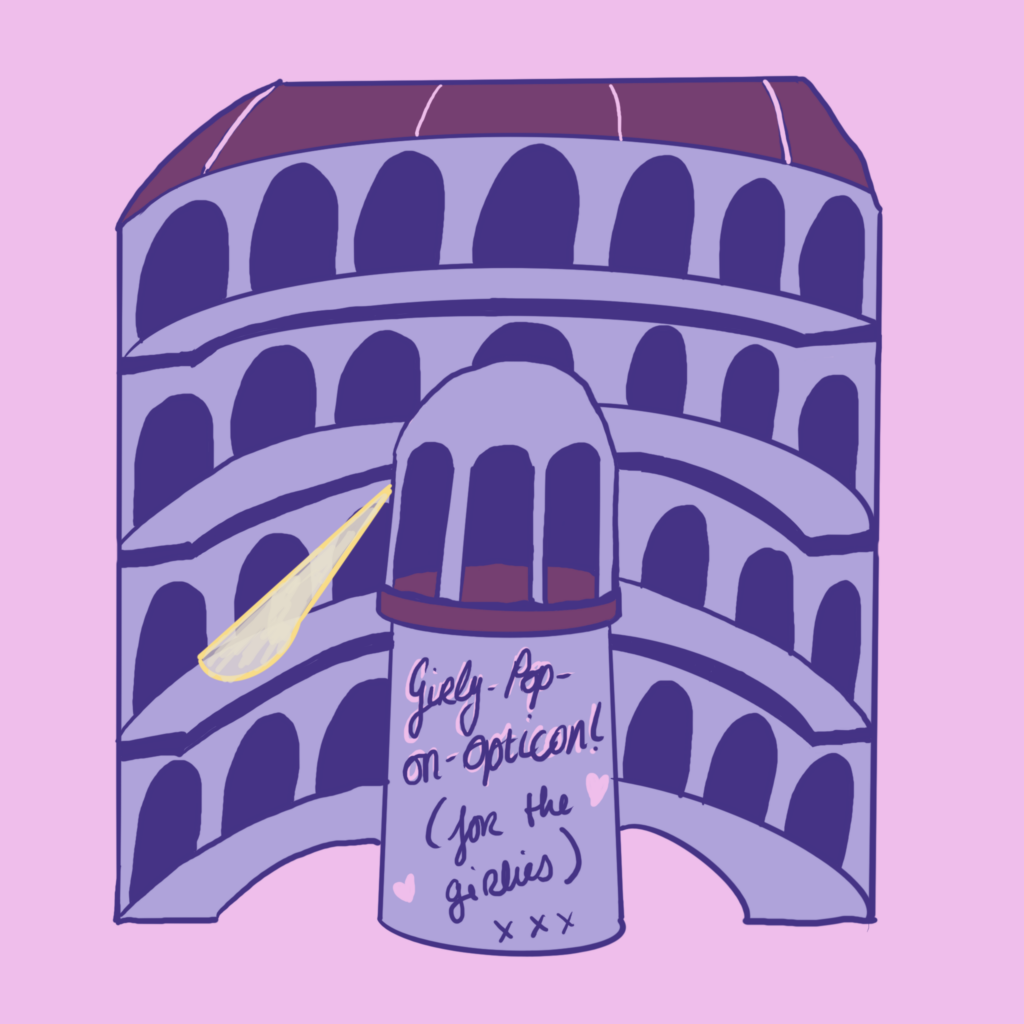
In this Panopticon, gender is performed for the Internet gaze, and women (girls) must feign that they do not perform at all for the male gaze. Men can now join in on the fun, and ridicule the women they feel perform too much for their gaze, using the terms they hear women using to ridicule one another.
Girls’ girls hoist their fellow women to the pyre, in the service of performing how little they care about male attention, crying accusations of “pick-me!” that sound an awful lot like “pick me”.